Praise for Fat Kid Rules The World

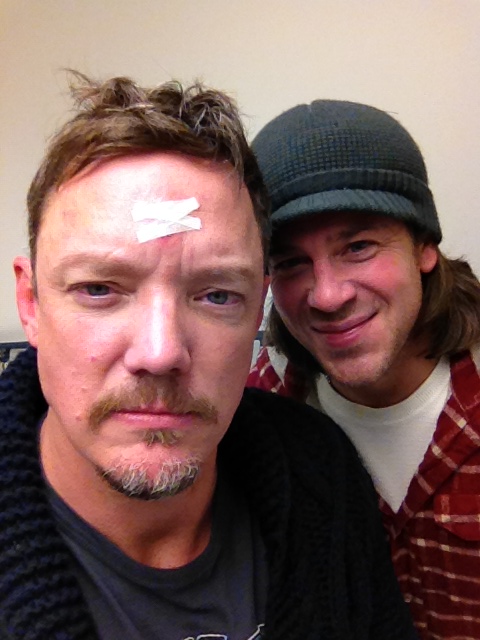
The DirectorLast night I saw the premier of the film “Fat Kid Rules The World” at the Seattle International Film Festival. The audience loved it and so did I.

This is the first directorial effort by Matthew Lillard, whose Hollywood career to this point has been that of an actor. That’s a big change, but there is something very consistent about Lillard’s interests: he has tended to portray people in their teens or twenties who undergo some sort of traumatic experience. Fat Kid is no exception to that rule. And, it is a thoughtful examination of the troubles that bedevil everyone at that age, some more so than others. The lead characters of this film are two rather screwed up individuals: Troy, whose serious weight problems and social ostracism have led him to the brink of suicide, and Marcus, whose expulsion from school and his mother’s home as well, have led him to life as a street kid.

This is not a mainstream Hollywood movie about beautiful teens who fall in love with vampires, nor a mega-hit stoked up on glittering superheroes. It’s a much grittier movie, and one that takes a sometimes painfully-honest look into the hearts and minds of high school kids and their parents. Don’t get me wrong, it’s not short on action. It won’t bore anyone. It’s got some pretty hair-raising moments in it as well as some good laughs along the way.

The KidThat’s all fine and dandy but the greatest value of this film lies deep in its heart. Can two misfits team up to overcome impossible problems? Or will the capacity of people around them to be crass and cruel overcome their gains and cast them back into the depths of despair they are trying to emerge from? Will Troy’s ultra-strict father destroy his own son while trying to help him? Can one troubled family tolerate another soul in need of help? Where can it all lead?

I don’t have space here to go into all the details of what makes this movie great, but I should point out that the cast, comprising veterans of the stage and newcomers as well, has outdone itself in providing riveting portrayals of characters with big problems, whose attempts to find redemption are heart rending to behold and inspiring as well. Young people who suffer from bad self-esteem should watch this film, not so much to take solace in watching a fellow sufferer, but rather to recognize that there is no hole so deep that a determined person can’t climb out of it.

One last thing. I mentioned that this is not a mainstream Hollywood film. After the premier showing, Matthew Lillard got on the theater stage himself along with some cast members to ask the help of us moviegoers with their plan to bring this movie to audiences around the world who need to see this sort of touching and positive film. They haven’t been able to get the financial backing of the big movie distributors, so they intend to spread the word without big corporate influence peddlers. They’re going directly to the people! In much the same way that I publish my stories without need of corporate financing, they’re hoping to get regular moviegoers to help them get this worthy story out there to the audiences who ought to see it: they’ve started a funding drive with small contributions by people like you and me, using the crowd-funding site, Kickstarter. If you’d like to help bring a thoughtful, touching, uplifting film to a wide audience, then check out the movie’s web pages, and then go make a small (or large) donation to the film on their Kickstarter Project page. I know I will.

Tagged , , , , , | Comments Off on Praise for Fat Kid Rules The World

Mudball Mars

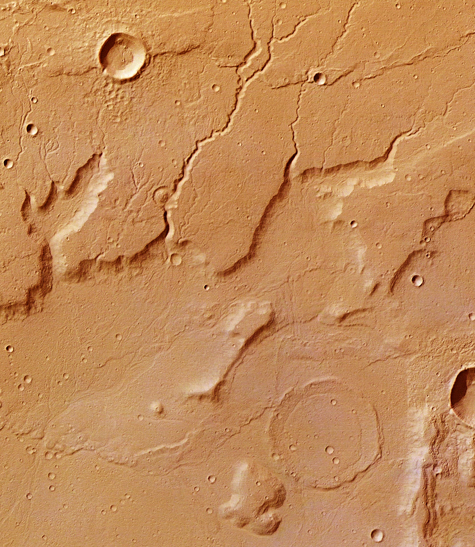
Martian mudflatsA lot of people think of Mars as a desert planet, racked by dust storms, covered in dunes, and dry as a bone. These things are all true but only just barely. Lately, scientists have been gazing at Mars from orbit and landing rovers on its surface that tell another tale, one implying a warmer and wetter world: a place of oceans, lakes, rivers and rain. So which is it then? Warm and wet or cold and dry?

Any astronomer worth his or her salt (and there’s plenty of that up there too) would tell you Mars is cold and dry, and they’d be quite correct. There’s no current evidence of water anywhere on Mars’s surface, just ice, ice and more ice. Any water vapor in the thin air tends to come down as snowflakes, further dehydrating an already dry environment. Even the atmosphere of carbon dioxide tends to freeze and fall from the sky as dry ice snow. It’s a pretty dry place.

But the landscape seen from orbit tells another tale and tells it pretty clearly. The photo above, snapped by a European space probe, shows that in addition to the craters we expect to see on most astronomical bodies, there are some pretty obvious signs of water, like those river channels running toward the bottom of the picture. Such channels are common on Mars, but they’re always dry. On Earth, we’d just assume that you need to wait for the next rainy season and they’d be filled with water, which we’d expect to see flowing down to lakes or oceans. In this case though, the empty channels flow into or out of craters, not ponds.

Or are they ponds after all?

Hip Wader CratersWhat is it that fills those flat-bottomed crater holes? Most scientists suggest lava, but I think maybe not. I’d say it seems just as likely that the craters are filled with the stuff water always washes along with it when it flows along channels and canyons: sand and mud. What if, back in warmer and wetter times, those craters’ deep bottoms were filled by megatons of water-deposited sand and mud, carried there bit by bit, century after century, by rivers and streams, until those craters took on that flat and mostly featureless look they sport today? Is that so impossible? I don’t think so, and I’m a bit of an expert, living in Seattle as I do, where mudflats are a common land feature.

On earth, mud and sand tend to harden and turn to rock over time, forming mudstone or sandstone. Alternatively mud, sand, and water can freeze to make permafrost, which takes on the properties of solid ground at ultra-cold temperatures like those found at Earth’s poles or everywhere on Mars.

So the landscape of Mars may be a desert in only the most superficial of ways, just on the surface and not at any depth beyond a few inches. In fact, the Phoenix lander’s retro rockets actually blasted the dusty covering off of a layer of white stuff the scientists decided, after more testing and talk than probably was necessary, was essentially pure WATER!

I’m going to jump ahead of the rocket scientists here and place a bet. I’ll bet MOST of Mars is covered by one form or another of ice, frozen mud, permafrost, or other forms of wetness that haven’t even been imagined yet. I’ll go a step farther and suggest that if you warmed the planet up a bit, you’d get one huge mudball — a real mean mess of muck. Mudball Mars.

Now it may seem I’m belaboring a point, but here’s the concept: future explorers of Mars may not be troubled by dust so much as by mud. As Kim Stanley Robison wrote in his Red Mars, Green Mars, Blue Mars series of novels describing the terraforming of Mars to make it habitable for people, there may come a time when water flows on the surface of Mars as it did in the distant past. But Robinson’s stories glossed over the issue of mud too easily, I think. When humans do someday change the Red Planet, be they so inclined, then I believe their greatest challenge will be figuring out how to deal with all the mud they’ve unleashed when they warm the place up.

I think soon I’ll write a science fiction story that takes a look at the challenges of life on Mudball Mars. Here’s a sample line of dialog:

“Eeew! Look at all the muck you’ve tracked into the habitation module! Now, who’s going to clean that up?”

Posted in From Outta Space, Real Science | Tagged , , , | Comments Off on Mudball Mars

My stories of space colonists

Where's Purgatory Crater?In these times when the dream of humans colonizing the other worlds in our solar system seems to get postponed over and over again, what can an author do to help maintain public interest in the subject? My choice has been to write adventure stories set in a near-future time when the first missions to establish human presence on our neighboring worlds have just begun. I’m an optimist, and I believe that those times are only a few years or decades ahead of us, and so an examination of the living conditions and behaviors of those first off-earth colonists seems in order.

It’s fun to take a conjectural look at the earliest outposts on the Moon or Mars, adding in a little human-interest coloration by considering what the living spaces and work areas might look like. However, it’s hard to hold most readers’ attention without something more. That something is usually conflict of one sort or another. I could write about different spacefarers quibbling over duties and daily routines but that would get boring petty quickly despite the exotic locale.

So, what’s a writer to do? How about — adding a murder mystery! Or a romance? Or both? After all, despite living millions of miles from their home world, space colonists will still be human. And human behavior tends toward drama, so there you go.

A prime example of one of my dramatized looks at humanity’s future in space is my short story, The Treasure of Purgatory Crater. See, it’s already got that dramatic element going in the title. Treasure? What treasure? And I don’t think I’ll be giving away too much if I suggest somebody might be willing to kill for this treasure, especially if it’s something “to die for.”

I’ve got more space adventures in the works, including one set in the first Mars settlement that I’ve tentatively entitled “The Air Maker.” Stay tuned for that one, but don’t hold your breath. It’s got some distance to go and a lot of editing before its release, which might be later this year or early next year. But when it arrives, it will surely contain all the best conjecture about that first Mars outpost that I can glean from current NASA documents and long-range plans. Oh, and again, how about a little mystery? A dead body, maybe? Starting to sound a little more interesting?

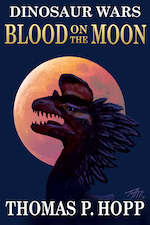
If you can’t wait for “The Air Maker” to give you a taste of intrigue in outer space, you could try my first novels in the Dinosaur Wars series, Earthfall and Counterattack. They take place on Earth in the immediate future (starting tomorrow to be precise) but each has at least a little reference to a south polar moon base (in this case, 65-million-years old). And coming soon, the third book in the series, Blood On The Moon, will take the reader to a mining complex at Phaeon Crater, where murder and mayhem abound, of course.

In my own way, I hope to increase public interest in space exploration by adding the exotic spices of mystery, murder, questing after power and wealth, and the attendant conflicts that characterize human societies wherever they may be. Read on!

Posted in Author, From Outta Space | Tagged , , , , , | Comments Off on My stories of space colonists

War Stories

TheSmallestCarrierWho am I to write war stories? Shouldn’t such tales be left to those who’ve actually lived through the horrors and the glories of life on the battlefront? I’d acquiesce to these hard questions in a second if life were simple. But it’s not, and there are a few things you ought to know about me and my life experience before you judge my fitness to tell these tales of heroism.

With titles like “Dinosaur Wars” and stories like my Uncle Herb’s harrowing military adventures in the South Pacific in World War 2, it’s clear I have a strong bent in the warrior direction. But in some ways, as you’ll see, my stories have chosen me, rather than the other way around.

Most blatantly clear is my call to write the horrendous details of Herbert Albert Hopp’s proud but personally devastating days as a gunner aboard a torpedo bomber in the Navy in 1943. While Uncle Herb is gone without having committed his experiences to paper, it just so happens that I am highly trained as a writer, and also that I have been bequeathed a huge number of photos, documents and reminiscences of his tale of heroism in one of the pivotal battles of World War 2. Who else can or will write it?

Regarding my choice to frame the Dinosaur Wars stories in a military scope rather than finding some way to return dinosaurs to earth without the need to invoke war, I simply found it unlikely that humanity would sit by while our planet was recolonized by terrors from the ancient past without putting up some sort of fight.

So, that’s the genesis of my choice of subject matter, but let’s also have a look at my credentials as a war chronicler.

There, like a stone wall, stood JacksonFirst, and most simplistic, is the fact that my ancestry includes the line that gave rise to Stonewall Jackson, who most historians agree was the greatest general of the American Civil War. He fought on the wrong side of that engagement, but it is also true that the South never lost a battle until they lost my Great Great Uncle Stonewall. So, some interesting blood runs in my veins. The fact that I share his first name, Thomas, and his birthday as well, adds a sense of deja vu to my connectedness to him. His military strategies are still taught at West Point and I have a sense that at least some of my inherent understanding of matters military comes at the instinctual level.

My own relationship with military service is an obscure one that I will try to elucidate here in a few words. In 1971, at the height of the Vietnam conflict, I was a college student with a good solid college deferment to excuse me from military service. Even though I was a long haired hippy of the first magnitude and was, and am, fundamentally against armed conflict in this world, nevertheless I saw the iniquity in the way the obligation was shared out among young Americans. I didn’t feel entitled to my college exemption from the war when others had no recourse but to go when called.

When the plans for a draft lottery were announced by the Nixon government, the whole concept of such a fatalistic approach to war service began to influence my thoughts and actions. I decided to cast my fate to the wind. I declined to re-register my student exemption as I was required to do every year and as a result I received in the mail a new draft card that listed my status as 1-A. I put the card in my wallet and waited to see what the draft lottery would bring. I didn’t mention my 1-A status to my parents, who would have freaked out at the prospect of their beloved son in the Army and risking his life in Vietnam for a war effort that they as well as many other parents had come to see as an unnecessary and unjustifiable cause.

As to my own inner thoughts during the weeks when that card was in my wallet and the lottery was drawing near, I can only tell you a few things. I was committed to the choice I’d made. If my birthday drew a low number, then I’d be getting all my long hair shaved off and shipping out to Nam in the not-too-distant future. If I drew a high number, then the draft would fulfill its allotment of young men and never reach my birthday, and I would be exempted from any military obligation for the rest of my life. I was truly at ease with the uncertainty of my situation. Exemption would reaffirm my hippy notions of living life in peace. Conscription by the Army, on the other hand, was the source of a lot of late-night thinking on my part.

I recall a line or two from a popular song at that time, Arlo Guthry’s “Alice’s Restaurant.” In it, he imagined trying to escape the draft by being declared unfit for service due to homicidal fanaticism. “I wanna eat dead burnt bodies,” he hollered. At the end of his exaggerated and humorous exploration of the subject, Guthry was supposedly disqualified for having littered. For whatever reason, the irony of the notion of me swinging from hippy pacifism to Gung-ho fanaticism stuck in my mind. If they draft me, I thought, I’ll show them the most murderous son-of-a-bitch that has ever hefted an M-16.
The luck of the draw released me from any obligation to make good on this half-threat, half-promise. I’ll never know what the effects might have been of the discipline of military training or the horror of facing another armed man who intended to kill me. I can’t and won’t defend or attempt to argue one way or another about any bravery or lack thereof that might lurk deep in my innards. I will never be tested.

Nevertheless, with all that said it is now I, the trained writer, who confront the need to tell stories that reach down into the heart of the warrior. Perhaps some folks will think I’m patently unqualified. Others, though, may see that in my way I am prepared by the willingness I once expressed to go and fight. That compels me to write these tales, as does and the inescapable fact that brave family forebears have lived the sorts of stories I intend to tell.

Posted in Author | Tagged , , , , , , , , , | 5 Comments

No Entry

Sorry, no blog post this week. I’m growing a beard.

Posted in Author | 2 Comments

What’s wrong with this picture?

Obsoletus rexHard to believe, but the movie Jurassic Park is obsolete. Remember seeing those eerily realistic eyes of Tyrannosaurus rex staring at you from the screen? Remember getting a chill from the awesome, scaly, lethal majesty of the killer king of the dinosaurs? Me too. But something’s gone terribly wrong with that image. You see, old rexy turns out not to be the scaly horror Steven Spielberg and Michael Crichton presented to us more then a decade ago.

Don’t worry, T rex didn’t suddenly decide to eat plants, or chill out until he’s just too lazy to bother chasing you down and chomping you into mush. No. He’d still be happy to do that, if you’d bring him back and plunk him in the middle of a bunch of people. But the Spielberg/Crichton image of the king decked out in scales from head to toe has come to its inevitable day of extinction. The movies that scared us so effectively with reptilian, armor plated terror have met their Waterloo.

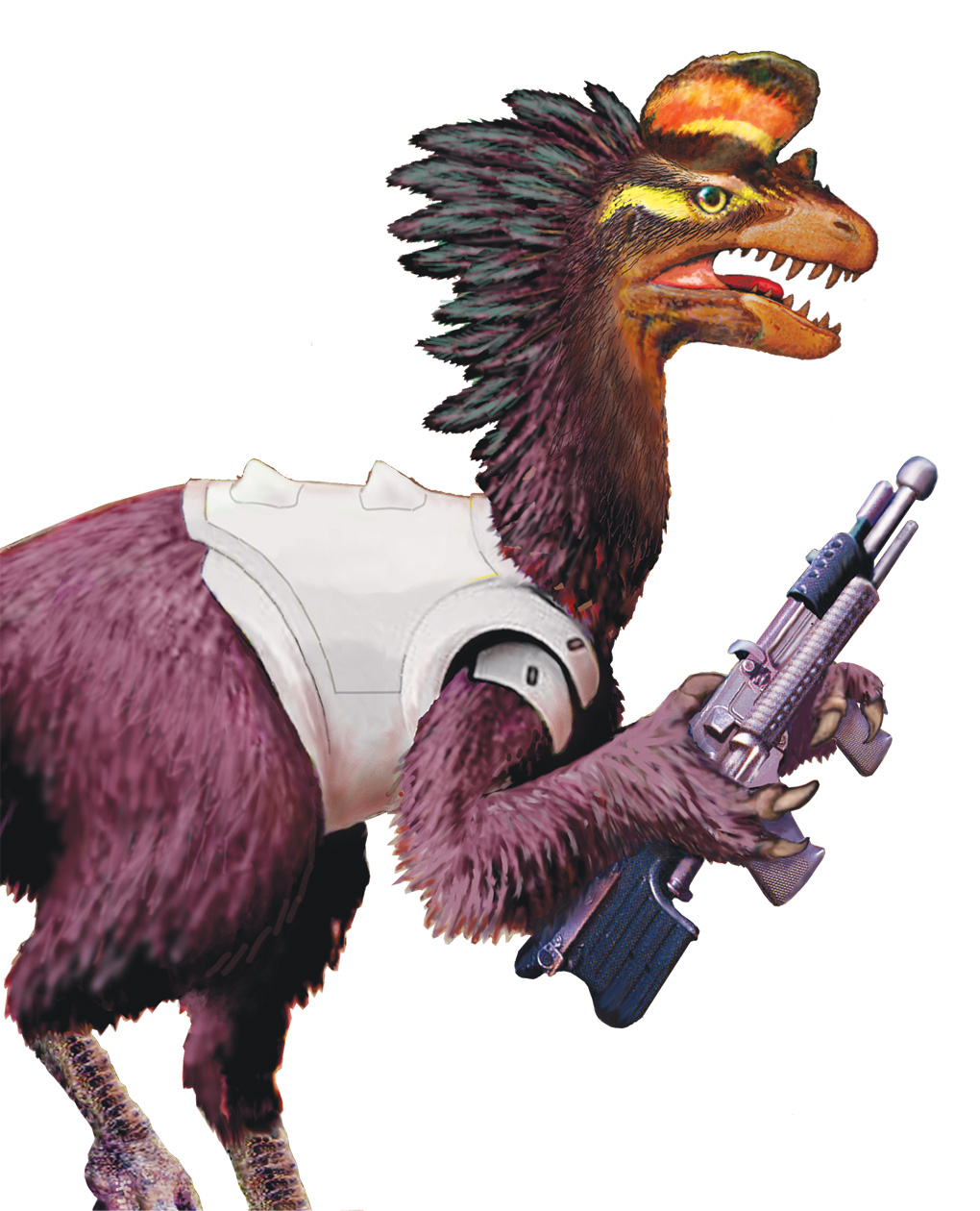
The New KingYou see, the Lizard King just isn’t, well, a lizard any more. According to new fossils discovered in China, rex and his relatives were covered in thick fur like wolves or grizzly bears. Bye bye scales. Hello the hair of his chinny chin chin. Don’t worry. Rex still retains his crown as the nastiest predator ever to stride the earth, and his appetite for eating critters the size of you and me in a single bite. He still commands the greatest measure of fear and respect. But those scary, scaly images in Jurassic Park? They’re passe. Part of a bygone era. Over with for good. Gone the way of the, er, dinosaur.

This has been coming for some time and I’m well prepared for this new day. You see, I’ve been putting wool on my dinosaurs for more than a decade, including a bristling mane on T rex. What next, a wooly duckbilled dinosaur? Oh yeah, they’ve found fossils of Edmontosaurus, one of the biggest of the duckbills, well above the Arctic Circle so get ready for that too. And by the way, I wrote about one of those in Dinosaur Wars: Counterattack way back in 2002. So there.

As I’ve been willing to tell anyone who’d listen for some time now, the time is right for a new Hollywood movie smash blockbuster hit, in which the dinos all wear coats of feathers and fur. Dinosaur Wars has been waiting in the wings and now, as real science catches up to my fiction writing, I think the time is right for a new screen image of the dinosaur. Sorry Spielberg. Sorry Crichton. Sorry Disney’s Dinosaur, and sorry all who made even earlier movies full of scaly monsters. Like an asteroid coming in from the heavens, scientific knowledge has brought the day of extinction down upon your images of dinosaurs, and ushered in the day of my furry and feathered friends.

Posted in Real Science | Tagged , , , , | 2 Comments

Kra Phylogeny

Meet Gar the KraI’ve been asked to explain the origins of the Kra, those intelligent, human sized dinosaurs that feature prominently in my Dinosaur Wars novels and short stories. So, here goes.

There are two ways of looking at this question. First, one can consider the semi-scientific idea that an intelligent species might have arisen during the Age of Dinosaurs, and wonder how that could have happened in the evolutionary sense. Second, given the long history of science fiction stories involving dinosaurs, how has the concept of fictional dinosaurian intelligence evolved over time? I’ll address both.

Among the paleontologists of our time, the notion of dinosaurian intelligence crops up more often than you might guess. Although no current dinosaurologist would risk his or her reputation by actually proposing a human-like intellect among the creatures of 65 million years ago, there have been plenty of scientific discussions of the brain power that existed inside the crania of Cretaceous creatures large and small. Scientists have published paper after paper describing relative brain-case sizes and comparing modern mammals and birds to tyrannosaurus, triceratops, velociraptor, and other dinosaurs. While the modern creatures almost always win out in terms of body-to-brain mass ratios, and thereby get scored as the smarter creatures, it’s not a slam-dunk issue when you start looking into the dinosaurs that perch closest to modern birds in the evolutionary tree. In fact, velociraptor and its cousins among the maniraptoran and dromaeosaurian lineages of dinosaurs are quite comparable to modern birds in that body-to-brain ratio. And among these, the subgroup of troodonts leads the pack with representatives that rank equal to modern birds, if not slightly higher.

Kra OriginsAs the diagram at right illustrates, I chose to place my “Pteronychus” species of intelligent dinosaur right smack in the middle between the brainiest of the dinosaurs, the troodontids and the dromaeosaurids. This placement leaves a little ambiguity as to the exact predecessors of the Kra (as the brainy Pteronychuses have named themselves), but I like it that way. That leaves a little authorial wiggle room for me to adjust the evolutionary tree if future fossil discoveries make a re-alignment of the Kra’s origins a necessity.

On to the second question. As far as the Kra’s literary predecessors, I can be quite a bit more definitive. The history of stories published about intelligent dinosaurs is pretty explicit, if you visit any library or cruise the web in search of the family tree. The real granddaddies of dinosaur fiction didn’t expend any significant ink on intelligence. For example, there’s nothing smarter than a lizard in Jules Verne’s 1864 Journey To The Center Of The Earth, or The Lost World, published by Sir Arthur Conan Doyle in 1912, although these authors get credit for having originated the entire genre of dinosaur adventure fiction of which my Dinosaur Wars stories are an evolutionary outgrowth.

Unless I’ve missed something in my research, the first writer to portray a dinosaur with speech, weapons and other trappings of civilization was Harry Harrison with his West Of Eden novel featuring the very lizardy Yilane, human-sized but very slimy and reptilian, published in 1984, almost simultaneously with a short article published by John C. McLoughlin entitled ‘Evolutionary bioparanoia’ in Animal Kingdom magazine, in which a human-sized, intelligent dinosaur species, shown below, was suggested as the possible culprit in the extermination of all dinosaurs at the end of the Cretaceous Era.

SmartosaurusA friend gave me McLoughlin’s article while I was writing my first Dinosaur Wars novel and I’m sure it had some influence on my thinking, although I didn’t go as far as suggesting as McLoughlin did, that dinosaurs nuked themselves into oblivion.

Next in the succession of intelligent dinosaur stories were the nearly simultaneous appearance of Robert Sawyer’s Far-Seer novel about intelligent dinosaurs living in a distant solar system, and Stephen Leigh’s Dinosaur Planet, published in 1992 and 1993, respectively. Also in 1992, came James Gurney’s highly acclaimed Dinotopia, in which most of the dinosaur species exhibited intelligence at one level or another. There are more books with smartosauruses in them, but too many to mention here and in fairness to myself, my own smartosaurus books came along in 2000 and beyond, so enough said.

There’s been an evolution in all this fiction that parallels the evolution in scientific thinking about dinosaurs. As time has progressed, fictional dinosaurs have gotten less slimy, less scaly, less cold blooded, and more feathery, more intelligent, and more dangerous in turn, up to and including wielding world-destroying power in the realm of fiction. I wonder what we scientists and novelists will think of next?

Tagged , , , , , | 4 Comments

Praise for John Carter

I just saw John Carter along with my father and son. We all loved it. The quality of the production is right there with Star Wars. The story line is excellent, and very close to Edgar Rice Burroughs’ original. In contrast to dozens of recent action films I’ve basically disliked for their excess of what I call “slam bang,” this movie had quite a few redeeming moments of humanity. At its heart, the pivotal transformation of John Carter from uncaring vagabond to invincible hero in his sword battle with a thousand green warriors is unparalleled in recent film history. The notion that the loss of his first wife fuels his conquest of an army, is, well, biblical, like Sampson, or mythic, like Jason. Never in any film until now, have I felt myself getting a little dewy eyed during a battle scene — but this movie got that reaction. Interweaving scenes of his present battle and his memories of his past greatest loss made me truly believe that even a mild mannered Jasoomian like me could rise to impossible feats if given the proper incentives of a murdered sweetheart and the desire to save a new love’s life. Top flight adventure stuff. And did I mention that the special effects and production quality were easily as good as Star Wars? Oh, yeah, I think I did.

Posted in From Outta Space | Tagged , | 1 Comment

Where have all the cities gone?

As the writer of stories about a lost civilization from the Age of Dinosaurs, I’m sometimes asked, “If there really was a civilization at the end of the Cretaceous Era, why has no one ever dug up a fossil clue to its existence?” That’s a fair question, but not as difficult to answer as you might imagine.

In my Dinosaur Wars novels and Dinosaur Tales short stories, I present the notion that there once was an intelligent species of dinosaur that became advanced enough to travel into space and then return 65 million years after their asteroid-mediated extinction, to reclaim their home world here on earth. Human beings, having evolved their own civilization in the meantime are to them just an inconvenient bunch of interlopers in the world they wish to own again. We think a lot of ourselves, but to them we’re just vermin to be exterminated or perhaps, er, um, well, eaten for dinner–or fed to their exceedingly voracious tyrannosaurian pets.

But I digress. Let’s take a look at the question of how a 65-million-year-old civilization could vanish, leaving no detectable trace. The best model is of course our own upstart civilization. If an asteroid dropped from the heavens tomorrow and exterminated us humans, what might some other species find 65 million years from now?

First of all, consider the fact that we don’t tend to build cities in environments where fossilization occurs. If a major metropolis like New York or Los Angeles were abandoned for millions of years, what would be left? Erosion works over centuries to turn the stone cliffs of mountain ranges into sand and dust. Buildings are just big stacks of stone, iron and glass. All of these materials would eventually just weather away, turning to sand, dust and a little rusty iron ore. And in New York’s case, another Ice Age might come along and a glacier or two would grind the whole place into tiny pulverized bits and pieces. Not much left to find.

What about other artifacts? Even the mighty hulk of the Titanic, lying on the Atlantic Ocean bottom, has begun to corrode away in less than a century. Given another couple hundred years, it will be no more than an orangey smear on the ocean floor.

Now, there are a few cities that might stand a chance of fossilization. New Orleans nearly became a fossil, in fact, when hurricane Katrina struck and swamped the place. If heroic measures hadn’t been taken to resurrect the Big Easy, then the Mississippi River would have dumped its sediments on the submerged parts of town and fossilization would have begun. But here’s the catch: there’s another major issue with fossils, namely, that most of them are still buried and won’t be found until they erode back out of where they have been buried. So who knows, maybe there is a lost dinosaurian New Orleans buried out there in the world somewhere, but until it comes to light, we’re stuck with the fact that exactly zero 65-million-year-old cities are known at present.

But what if we just found some artifact of civilization, not the whole bloomin’ thing? Some widget or gadget that managed to get preserved in 65-million-year-old sediments? One problem in that case might be whether or not to believe it. In the creationism/evolution debates that rage these days, there are a number of creationists who go to great lengths to point out human artifacts that are found below dinosaur bones in various geological settings, thereby claiming that humans and dinosaurs coexisted before the Great Flood. Their geological arguments are flawed, of course, but they persist and have many followers. So who knows, maybe some Cretaceous gear or sprocket or bedspring has already turned up, only to get swept into those debates, becoming a curio rather than a scientifically documented case-in-point.

So there you have it: extreme rarity of preservation of anything from 65 million years ago, combined with confusion over the few artifacts that might be found, would result in the public being unaware of any notion of dinosaurian civilization until the heroes of the Dinosaur Wars stories were confronted with a nasty new reality: Dinosaurs were civilized, and… they’re back!

Tagged , , , , | 2 Comments

Anatomy of a Killer Hormone

Human Chorionic GonadotropinMy colleagues and I at CG Therapeutics, Inc., are at war with a molecule that brings much joy to this world but ironically much suffering and death as well. Human chorionic gonadotropin (hCG) is a protein hormone that is pretty well known, due to its place of honor as the substance that turns the pregnancy test kit blue (or purple or red or whatever color your kit turns). Rightly, a person ought to be overjoyed when the kit goes blue, but in some cases the news is met with less than thorough delight.

Furthermore, hCG has a downright evil side to it. When cancer cells begin to produce the pregnancy hormone, it helps them to spread and grow faster, while it simultaneously begins to shut down a person’s immune responses that would normally attack and kill the cancer. Somehow, the hormone of birth becomes the hormone of death. That cruel irony is the focus of work at CG Therapeutics. We intend to develop a vaccine that can block the function of hCG in cancer, giving patients a better fighting chance to resist and destroy the tumors that are trying to destroy them.

To create our vaccine, we dismantle the hCG molecule and inject inactive pieces of it into patients in a formulation that is much like a flu shot. Let’s have a look in detail. Above, the structure of whole hCG is shown with its two chains color coded. The alpha chain is shown in shades of pink and the beta chain is shown in shades of yellow. Click the image for a larger view. The alpha chain is common to a number of hormones besides hCG, for instance, thyroid stimulating hormone, which enhances the body’s energy metabolism, and also luteinizing hormone, which stimulates the sex drive among other things. We at CGT have no desire to monkey with either of those body functions, so we are not targeting the alpha chain.

However, the beta chain is another matter. Each of the hormones I just mentioned has its own unique beta chain, which pairs with the alpha chain to form what scientists call heterodimers, which possess the functional properties of the hormones. So, if you knock out the hCG beta chain, you can inactivate hCG without messing with levels of thyroid or sex hormones. That’s a nice idea, but how do you do it?

hCG LoopHave a look at the second image, where I’ve zoomed in on the right side of the hormone and color coded things a bit differently. Part of the formerly pink alpha chain has gone green, and part of the formerly yellow beta chain has gone blue, just like the test kit. You can see what I’m getting at by looking at one or the other of the two images, but if you’d like to try to get a real three-dimensional feel, try fusing the two images into one stereoscopic, 3-D view. How? Look in the dark blue space between the blue arrows and let your eyes unfocus. Think about looking far away, as if the dark blue background were the night sky. You should see two images of the arrows come together and fuse into one arrow. Now look down at the molecule. Is it in 3-D? I hope so. If you have trouble with this trick, click the image for a larger version. Try again. If that still doesn’t work try to adjust the size of the picture larger or smaller until the arrows have approximately 6.5 centimeters between them. That helps because it’s the average distance between people’s eyes and you want to be looking straight ahead, not crossing your eyes.

Anyway, that looping blue structure is the part of the hCG beta chain that we at CGT have been paying particular attention to. When a vaccine causes a patient to make antibodies that bind to that loop, the antibodies not only stick to hCG but they block its activity. That’s a pretty useful outcome for cancer patients because we’ve already demonstrated in clinical tests that many patients with advanced cancers live significantly longer when their bodies produce some “anti-loop” antibodies, as we call them.

We keep trying to increase the efficiency of our vaccine by subtly changing the nature of the loop fragment that we put into our formulation — a little longer, perhaps, or maybe shorter might work better. And there are other tricks to be tried with the loop that I don’t have time to go into here.

Finally, once a vaccine that blocks hCG is fully developed, we’re considering another use for it. It is quite possible that when formulated just right, this anti-cancer vaccine could also be an anti-pregnancy vaccine, stopping pregnancy before it starts. hCG is the pregnancy hormone, remember? Given that overpopulation is one of the gravest threats to the future of humanity, you may not be surprised at a phrase we at CGT occasionally quip in lighter moments of our otherwise arduous journey: “Once we’ve cured cancer, we’re going to save the world!”

Posted in Real Science | Tagged , , , | 2 Comments