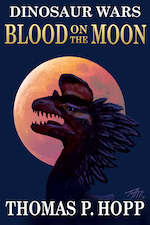
Tyrannosaur Valley

Chase Armstrong, National Director for Reintroduced Species and Special Advisor to the President, was called in to investigate reports of the consumption of several campers in the Sioux Charley Lake area of Montana by one of the Tyrannosaurs recently introduced into the region by the returning — some say invading — Kra.

Locals are calling the place Tyrannosaur Valley because of the many sightings of the huge carnivore, and the growing number of unexplained disappearances of hikers, campers, hunters and trout fishermen.

Long a favorite recreational area, since the reintroduction of T rex, the area is less well known as a trout creel heaven and more a place to keep a lookout behind you for the stealthy approach of the ten-ton carnivore. The beasts reputedly move with none of the tree-toppling uproar of their Hollywood image. Instead, they are remarkably light on their feet, silent stalkers until the moment they bellow loudly enough to split a tree, as attested by those who heard and lived to tell. Then comes a charge that shakes the ground like a semi truck is on the move.

Of course, by the time you’ve tuned into the noise of the charge, you might as well “bend over and kiss it goodbye,” says Dr. David Ogilvey of the nearby Institute for Dinosaur Studies.

“Tyrannosaurs didn’t get to be the top predator in the ultimate big game hunt of Cretaceous times by being big, galumphing idiots. Hardly. As we see now in their new incarnation, they’re incredibly fine-tuned, crafty and quick creatures, with hawk-like, intense eyes. Yet they’re sized to be capable of taking down big three-horned herbivores, immense stampeding duckbills or thunderous long-necked titanosaurs with exemplary swiftness. Small wonder that humans at Sioux Charley Lake seem like tender and easily subdued junk food to a T rex. The campground at Indian Charley Lake has become a sort of local convenience store for T rexes to stop by for a quick snack.”

Chase Armstrong was not available for comment until one reporter caught up with him in the field at Tyrannosaur Valley, where he was preparing one more in a lengthening series of fatality reports. In response to queries regarding his agency’s plans to avoid future tragedies he said, “People have got to understand a tyrannosaur is a tyrannosaur. You can’t tell them what to eat. Every now and then, it’s going to be a human. I feel very sorry for the families of the victims but at the same time, keep in mind that we humans have caused a lot of death and extinction in this world. So maybe what goes around comes around.”

Asked if he was expressing a new policy for the Administration, Mr. Armstrong said, “Not really. There has always been an understanding that big predators like grizzly bears in the Yellowstone area would occasionally take down humans. We’ve just got the same problem on a larger scale with T rex. Right now we’re developing a risk management plan but I can tell you, the simplest thing to do is avoid areas where T rexes congregate, like Tyrannosaur Valley. There are other good fishing spots without the risk of being bitten by anything bigger than a mosquito.”

Tagged , , , | Comments Off on Tyrannosaur Valley

Help wanted

Long before I publish a story I begin researching information that will make the story informative as well as entertaining. This post kicks off my search for information about the brave American aviators who flew against the Japanese Imperial Fleet in World War II. In particular, I’m trying to “make it real” by turning up details about the experiences of my Uncle Herbert A Hopp who flew in a Grumman Avenger torpedo bomber and was shot down over New Georgia Island in the South Pacific.

Anyone having information bearing on the battles, ships, aircraft and human events of that time in history, please reply. I have a long road of research ahead of me to fill in the details.

I intend to develop a story of wartime courage, discipline, heroics and tragedy. Herb’s time in the war zone was incredibly brief. He was put ashore at Guadalcanal on February 1, 1943 and sent out in an Avenger attack on a Japanese task force on February 4. He was shot down on that day. Herb was a turret gunner and was credited with one kill of a Japanese Zero fighter and a probable second kill. His pilot, mortally wounded by flack from the ship they attacked, put the plane on autopilot aimed for New Georgia Island. Pilotless, the Avenger crashed into a jungle of giant trees, leaving Herb wounded and alone, the only survivor. He crawled through the tangled, muddy, malaria infested swamps of New Georgia for three days until he got to a native village where he was rescued by a float plane.

I’ve already turned up Herb’s service record (664-09-50) and his medical record, which describes his horrendous injuries: shrapnel wounds in multiple parts of his body, including a large fragment in his forehead and several pieces next to his heart. He used to tell a story of having to dig a Japanese Zero bullet out of his breastbone with a stick while on the island.

Herb accounted for himself well with his two kills — one theory goes that a shortage of Zero pilots is THE reason Japan lost WWII. However the crash, his injuries, and having to bury his dead crew mates took a toll. Back in the states, he descended into alcoholism and destitution, the fate of many servicemen suffering post traumatic stress syndrome, reliving the horrors he’d witnessed in dreams and waking nightmares.

I plan to write a novelization of Herb’s story to bring out the bitter human truths that surround war and the lives of individuals who undergo its rigors.

Uncle Herb’s story is the tale of a war hero even though it ends sadly. I’ll do my best to bring it to light in the interest of illuminating the price paid by fighting men and women in every generation since time immemorial.

Tagged , , , , | Comments Off on Help wanted

Dr. McKean’s New Genetic Code

When he was working for the CIA, Dr. Peyton McKean created a means of writing English using the four code letters of the DNA genetic code (A, T, G and C). He assigned the 26 letters of the English alphabet to groups of three DNA letters, which geneticists call codons. Scientists already had such a code table, referred to as The Genetic Code, but it lacked assignments for 6 of the 26 letters of the English language. McKean fixed that, and came up with the modified code table below, which possesses a complete set of English letters. Notice the six “not equal” signs (≠). These mark the only codons of the original code that Dr. McKean needed to change to get his new DNA-to-English code.

Peyton McKean's New Genetic Code

This new code table allowed Dr. McKean to insert DNA into genetically modified organisms, carrying secret information in English sentences. Most DNA sequences are randomly scrambled letters that look like gibberish to the English reader, but now it is possible to conceal in the middle of an organism’s DNA, a sequence of seemingly random DNA letters:

ACGCATATCAGTTAAAGAGGTCGAAATAATAGCATG

which actually are the first letters of the phrase:

THISORGANISMWASOBTAINEDFROMUNITEDSTATESCLASSIFIEDSTOCKSITIS

ACRIMETOPOSSESSDISSEMINATEORGENETICALLYALTERTHEORGANISM

WITHOUTUNITEDSTATESGOVERNMENTCLEARANCE

When I asked him how he specifically uses his coded organisms, Dr. McKean flashed me that intellectual smirk of his and replied with the classic, “If I told you that, I’d have to kill you. Suffice it to say that microbes bearing messages hidden in their genomes have become a fact of life in national and international covert operations.”

I have a hunch that someday soon a criminal or espionage case involving such a microbe will be unveiled. Meanwhile, be Dr. McKean’s guest: try writing your own sentences in his code. Or, if you’re really ambitious, search within the human genome and find some words or sentences already written there by God or Nature. Who knows, maybe great revelations await, written in the A’s, T’s, G’s and C’s of your very own DNA?

More on this in a future post.

Tagged , , , , , | 1 Comment

News from Dinosaur Country

Entries on this thread will record the newsworthy events that transpire almost daily since living dinosaurs returned to Yellowstone Park and the plains of eastern Montana. Although most people have yet to make vacation plans to come and see the incredible flourish of living fossils, I have the privilege of a bunkhouse room at Will Daniels’ Twin Creeks Ranch in the heart of dinosaur country, where creatures of every type from the late Cretaceous Era now roam, fly, creep and thunder.

It is my purpose to present some new views of dinosaurs, not as dusty skeletons in museums or rubberized animatronic robots, but rather as the living, breathing, braying, fighting and loving creatures they once were and now are again.

Mercifully, the dark days of warfare that brought them here have passed, thanks to a truce struck by humans and the Kra, dinosaurian former masters of the earth. Even though most people feel the war ended victoriously for humankind, nevertheless the Kra can hold their dinosaurian heads high – about eight feet high in a healthy adult specimen – because their invasion from space was not completely repulsed by us humans, and colonies of dinosaurs exist now on all continents including North America. At Twin Creeks Ranch, the Kra are celebrating their return to their capital city, Arran Kra, in a frenzy of excavations bringing the 65-million-year-old ruins back to light after an epoch encased in the rocks of Sandstone Mountain.

The forests, hills and plains around here are teeming with plants and animals of the past. While I have no formal training as a paleontologist, I am exceedingly lucky to have access to the illustrious Dr. David Ogilvey, long-time Montana dinosaur expert and recently-named head of the Institute for Dinosaur Studies at Arran Kra. Dr. Ogilvey’s long career began with studies of old bones, but recently he’s shifted to living examples of dinosaurs large and small, which he describes in field reports telling of life histories and behaviors that are often quite amazing.

For instance, did you know that tyrannosaurs sit on their nests to incubate their eggs? How they do that without smashing the little delicate things is quite beyond me at the moment, but I promise a full report as soon as I can sit down with Dr. Ogilvey and get the details.

I’d be remiss if I ignored Kit Daniels, Will Daniels’ daughter, a college student majoring in paleontology and the first student enrolled for training at Dr. Ogilvey’s new Institute. She is also the first student in the history of the world to have such an incredible class project: to prepare a complete, fresh skeleton of a Tyrannosaurus rex for display at the American Museum of Natural History in New York. That’s right, I said a fresh skeleton. She is right now in the process of cleaning the skeleton of the huge rex killed by Chase Armstrong in the unfortunate fighting during the dinosaur invasion at Twin Creeks Ranch.

I’d also be remiss if I didn’t give the intrepid Chase Armstrong his due. Yellowstone Park Biologist and wolf reintroduction specialist, Chase has long been handy with tranquilizer darts and rifle. Now, these tools of his craft have been adjusted to the larger doses he must deliver to the new targets of his research. Beyond wolves, he’s now a dinosaur reintroduction specialist as well, whether he ever wanted such a thing or not.

I’m sure each one of these people is still in shock from suddenly finding dinosaurs all around them. But each is made of the stuff to bravely forge ahead in the new and unknown world that presents itself daily.

This note and notes to come are small tastes of the intense, daily barrage of things dinosaurian here at Twin Creeks Ranch.

I’ll do my best to keep you informed.

Next: Tyrannosaur Valley

Tagged | Comments Off on News from Dinosaur Country

On The Exploits of Dr. Peyton McKean

Hello. My name is Fin Morton. Phineus, to my mother. I’m a writer specializing in medical subjects. Once, while pursuing a story, I met a most peculiar and impressive man, Dr. Peyton McKean. Without giving an excess of detail in this short post, just let me say that I have become an avid follower of the man, and hope to someday have written as prolifically about Dr. McKean’s adventures in crime solving as John Watson did about the doings of Sherlock Holmes.

By tagging along with McKean on several recent cases, I have already had the privilege of publishing two memoirs, one a short story entitled “Blood Tide,” regarding the red tide poisoning of a geoduck fisherman, and the second an entire book on the case of The Jihad Virus.

More is sure to come in the future, as Peyton McKean is in demand for his skill as a biotechnology sleuth. Let’s put it this way: he doesn’t so much use DNA tests, as he invents them. I’m excited about whatever case may be coming along next, and I intend to keep everyone who will listen — or read — fully informed on the intriguing life of the man billed as “The greatest mind since Sherlock Holmes.” Okay, so I made that last bit up myself.

Tagged | Comments Off on On The Exploits of Dr. Peyton McKean

Testing testing

You’ve gotta start somewhere. This is post one for me. On this blog, I plan to share with readers some entertaining and enlightening communications I have received from certain people you may have met in one of my stories. Among them, Dr. Peyton McKean, whom I have billed as “The Greatest Mind Since Sherlock Holmes,” will try to live up to his reputation as a scientific crime investigator of extraordinary skill. Those following the adventures of Chase Armstrong and Kit Daniels of “Dinosaur Wars” fame, will learn of the latest doings of these two young people as they struggle to live, love, and avoid being eaten, in a world filled with huge beasts of the past. Or Dr. David Ogilvey, their old paleontologist mentor and head of the Catterall Institute in Montana, who knows better than anyone how dinosaurs managed to return to earth — from outer space!

Whether the news comes to me from Dr. McKean and his medical writer sidekick, Fin Morton, engaged in some intrigues with a new bio-weapon, or from a dark corner of the 65 million-year-old buried city of Arran Kra, now under excavation in Montana, I’ll try to faithfully pass it along without undue delay, and of course without censorship. Why delete any detail of the breathtaking scientific leaps these people are making? Why ignore their day to day tribulations, as when Dr. McKean had to cure himself of a deadly engineered smallpox virus before he could go on to save the world? If Chase has to defend Kit and Dr. Ogilvey from a T rex attack armed with nothing but a stick, why not tell the world?

I hope you’ll come by from time to time to see what new trouble these folks have gotten themselves into — and out of.

Thanks for stopping by — Tom Hopp

Posted in Uncategorized | Comments Off on Testing testing