Death’s Head Dog

A Dangerous BreedDoes this picture make you nervous? Do this canine’s markings seem just a bit too close to a skull for comfort? I thought I’d share this scary gem a few days before Halloween just to get into the spooky spirit of the times. Spookier still are some facts about this animal. It is a genetically modified dog, possessing some of the genes for human intelligence. It is pregnant, having bred with a coyote last time it came into heat. It is out to take over the world.

That’s so much like my short story “A Dangerous Breed” that I can hardly believe it.

Oh, wait. It is my short story “A Dangerous Breed.” Click the picture for a close-up look, if you dare. You see, I’ve been creating a cover for the story, which will be released any day now in all ebook formats, hopefully in time for Halloween but if not then shortly after while the season is still witching. I hope you’ll check it out when it’s available. It’s about the scariest story I have ever written, my “Hound of the Baskervilles,” and if I may be so bold, a hair scarier than that venerable work by the great Sir Arthur Conan Doyle. My heroes Peyton McKean and Fin Morton spend so much time trying not to get eaten, it’s a wonder there’s any time for detection in this tale at all.

I made the image by rearranging the coloration of a Border collie’s face to match the “Death’s Head Bitch” in the story. Get ready to be scared.

Posted in Uncategorized | Tagged , , , | 2 Comments

Dinosaur Wars: Meet Dr. Ogilvey

Jack HornerEvery good adventure story needs a mentor figure. A wise old bird. A teacher. A guide. Without a mentor, young heroes can go wrong as they quest for whatever they need — salvation, victory, riches, love, survival, you name it. The mentor figure is a classical archetype found in all manner of stories from ancient Greek myths to modern theater box office hits. For instance, Luke Skywalker needed tons of help from his mentor, Obi-Wan Kenobi, or he’d never have made it through the rigors of Star Wars. Indiana Jones never could have found the Holy Grail without help from a classic mentor figure, his father. Dorothy sought the help of a fearsome mentor for virtually the entire time in The Wizard of Oz, only to be helped to get home easily by her real mentor, Glenda, the Good Witch of the North.

In Dinosaur Wars, the mentor figure is Dr. David Ogilvey, an old, owlish curmudgeon of a paleontologist who is studying dinosaurs on Kit Daniels’ ranch when the invasion begins. Like other mentors before him, Dr. O is possessed of certain sterling qualities that make him the go-to guy for both Kit and Chase Armstrong as they strive to survive and prevail against dinosaurian threats on all sides.

Like good mentors everywhere, Dr. O is possessed of hidden knowledge that he must impart to the heroes. For instance, it is he who has already discovered the lost 65 million year old civilization of the Kra. He’s been ostracized as a crackpot by mainstream scientists, and that exile to the wilderness is part of the makeup of good mentors. He’s actually ahead of everybody else and they just don’t know it. So he becomes the only person able to accept that intelligent dinosaurs do indeed exist, and begin to deal with them.

He learns their language. That’s another hallmark of good mentors. He can communicate with un-human creatures and wild things, to learn more special knowledge that leads the heroes forward in their quest.

So, who is this character, anyway? I’ve written about him quite a bit in Dinosaur Wars: Earthfall and the upcoming Dinosaur Wars: Counterattack, as well as in the short story, Something in the Jungle. As I’ve said, he strikes one at first glance as rather owlish (same disguise Merlin used to tutor Arthur, remember?). He’s rather rounded in form, with boney knees beneath his khaki shorts and oversized feet in clunky hiking boots. His gray-bearded cheeks and thick eyeglasses add to his large-eyed, owlish appearance. Place a dusty canvas field hat on his head for frumpiness, and you’ve got the makings of a gritty, hard-bitten, sun-scorched old bird who’s just the right person to offer advice on dinosaurs and how to deal with ’em.

Dr. O?The picture above looks a bit like Dr. O, but of course it’s really the famous paleontologist, John R. (Jack) Horner, a man whom I’ve worked for in his dinosaur digs in Montana. He’s a good role model, but not quite right. He’s really just a bit too good-looking to make a perfect Dr. David Ogilvey. Maybe someone like Teddy Roosevelt might have the looks dialed in just a bit more. I can imagine him voicing Dr. O’s characteristic high-pitched “Heeh!” when he laughs. But even Teddy doesn’t quite evoke the real Dr. O.

I suppose I’ll just have to wait for Hollywood to make a movie or three out of my stories for a real good look at Dr. O. Maybe they could cast a great actor like Val Kilmer with some padding around his mid-section, a beard and coke-bottle glasses? That might get it about right. Remember Val, “Heeh!”

Tagged , , , , , , , | Comments Off on Dinosaur Wars: Meet Dr. Ogilvey

Dinosaur Wars vs Terra Nova

Old Skool DinoAs I complete the writing of my second Dinosaur Wars book and dream someday of seeing it on the big screen, the arrival of Steven Spielberg’s dino series Terra Nova has had me on the edge of my seat (well, couch). Thankfully for my Dinosaur Wars ambitions, I see HUGE differences between Spielberg’s effort and mine. It would seem there is room for my story even in the presence of the eminent director’s latest foray into the realm of extinct species.

Here’s why. First, the dinosaurs of Terra Nova seem incredibly old-hat to me. They’re still the leather-skinned, scaly stompers we’ve seen for years. Where’s the feather coating we now know covered the meat-eaters like the feathers on hawks? What about the fur coatings the plant eaters had? Hasn’t anyone updated Steven on these matters? Click the slasher image to read the Smithsonian Museum’s disapproving review if you think I’m the only one with issues here.

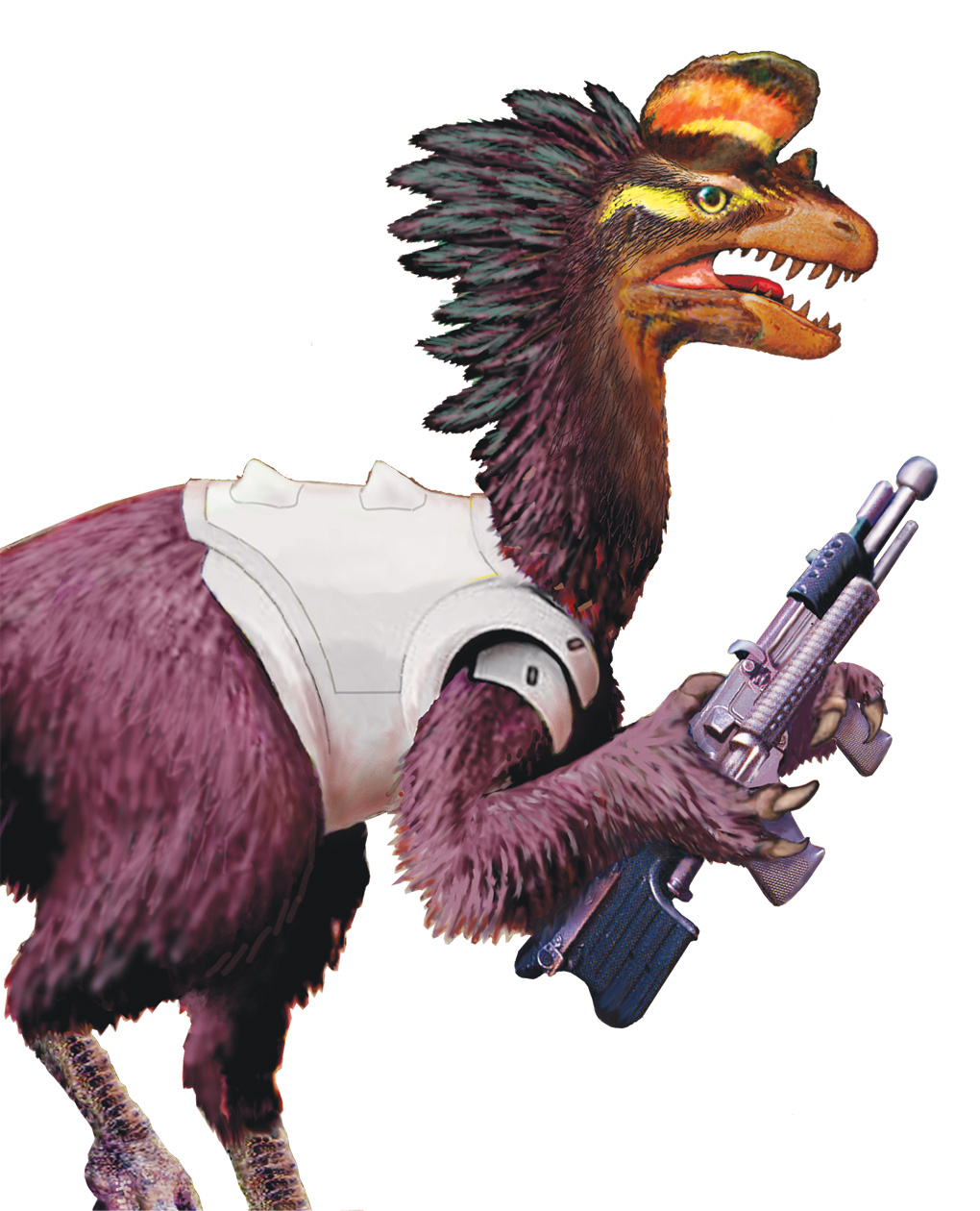
Gar the KraCheck out my feathery, extremely bird-like Kra (right) for a look at a much more up-to-date theropod dinosaur. By the way, did Spielberg’s animators use my Gar, the Kra for inspiration when developing their crested meat eating “slasher” dinosaur (above)? I think maybe so. Mine came first, Steve, so nyah-nyah! Click Gar’s image for a more detailed look at his feathers and weapons.

Second, who’s that gray-bearded dude running the show on Terra Nova? Do we really need to escape to a new world where old men are constantly telling us what to do? I’ll hold up my young heroes, Chase Armstrong and Kit Daniels to that old buzzard any day. Chase and Kit are very young and very central to my plots, much like Luke Skywalker and Princess Leia. Sure, there are young people on Terra Nova but the show just isn’t ABOUT them the way Star Wars was about Luke and Leia, and the way Dinosaur Wars is about Chase and Kit.

Third and finally (for now), what’s all that about an apocalyptical future earth and a time-travel escape to the past? Sorry, but I just HATE both of those dramatic tricks. Sure, we all worry about a possible apocalypse some day but right now we don’t live in one. And sure, time travel would be cool but it doesn’t exist–now or ever–otherwise we’d have future people stopping by to visit us all the time. I much prefer the world of Dinosaur Wars, namely THIS WORLD, the one we currently live in.

Even though my choice of having dinosaurs return to earth in a space invasion is a stretch of credibility, the end result is easy to relate to: dinosaurs roaming the present-day plains and mountains of Montana and other parts of the world, and a war against the leaders of the invasion using current-day tanks, helicopters, and guns.

Placing dinosaurs on a tropical island as Jurassic Park did, or in a distant time-travel future or past as Terra Nova does, is a poor choice if you want folks to relate to the creatures and people in the stories. I’m confident that Kit and Chase and their present-day, up close and personal predicaments with dinosaurs, are the best means to present not only an adventure story but a solid romance tale as well.

And I’m convinced Dinosaur Wars will someday be seen as the best dramatic incarnation of dinosaurs, eclipsing Jurassic Park, Terra Nova, and all the others by dint of my having conceptualized the story with all the elements that make up a good tale. I’ll keep writing with the expectation that someday a major motion picture or two or three will result. Check out my books if you haven’t yet, and keep your fingers crossed about the movies.

Posted in Author | Tagged , , | 7 Comments

Dinosaur Wars: Mapping the Sequel

Olympic Peninsula BattlesAs I work in a frenzy to complete my revision of Dinosaur Wars: Counterattack, I find it useful sometimes to refer to a map of the action. Here’s a diagram of Western Washington, showing the details of Victor Suarez’ valiant effort to quell a Kra invasion from the shores of the Olympic Peninsula. It’s one of the central events of Counterattack, and it’s the fount of quite a bit of excitement for readers who like a good battle scene. There are plenty of ’em here.

Click it for a closer look.

Posted in Author | Tagged , , , , | 4 Comments

More Brooding Dinosaurs

Oviraptor on eggsIn my previous post I offered you a quick look inside the world of paleontology and the new insights scientists are drawing from the fossil record of dinosaurs. Let’s take a closer look at how wing feathers may have evolved for the purpose of brooding, as opposed to the purpose of flight.

The image above was published in the journal, Nature, by the team of scientists who uncovered the incredible fossil of a brooding oviraptor that died while defending its nest from a sandstorm. It’s a “reconstruction,” or schematic drawing in which the various bones and eggs that were preserved in their specimen are complemented by the addition of some missing bones to complete the skeleton and an outline of the nest of sand, as well as an outline of the animal’s body shape.

That’s a nice diagrammatic way to look at how a dinosaur parent could nestle down on its eggs to keep them warm or shade them from hot sun or fend off a desert rain squall. What was left for Mark Orsen and me to do after this paper was published was to explain how feathers might have evolved to help the oviraptor shelter its eggs and the hatchlings that would come from them.

Evolving feathersThis is another of Mark’s images. Here he shows how the short feathers of a primitive bird-like dinosaur could have increased in size over time, driven by evolutionary survival pressure. Three stages of evolution are shown. In the first, a short feathered ancestor can cover only a relatively small area with its “wing” feathers. This is a survival disadvantage because only very few eggs or babies can be protected, compared to the nice big clutch of eggs shown in the diagram above. This ancestor would never have been able to shelter all the eggs that were found in the fossil nest.

Over millennia, pressure to raise more young, or to protect them as they grew bigger, would naturally lead to the lengthening of the feathers. One nice feature of this theory is that it is gradual, not sudden. Other theories of wing feather evolution suggest the animals were jumping out of trees and flapping their arms with stubby feathers or trying to glide with them. Still others suggest that the animals were trying to leap up off the ground and fly. All of these flying-came-first theories fail to solve the problem of the intermediate stages. That is, what happened during the times when the feathers were too short for flight or gliding? A lot of crash-landings, it would seem.

On the other hand, Mark and I have proposed a theory in which every length of feather, from the stubby ones to the long ones seen on the right, would be a useful length — it just depends on how many babies, or how large a brood, the adult was trying to shelter. Each little increment of feather lengthening meant another egg could be laid, or a larger baby could be protected. These are key survival issues for any species of nesting creature, from tyrannosaurs to chickens.

So, maybe it really did happen that way. Maybe the wing, which we naturally associate with flight, evolved first for the other purpose we sometimes forget, namely brooding. That’s what Mark and I think.

Posted in Real Science | Tagged , , , | Comments Off on More Brooding Dinosaurs

Brooding Dinosaurs

Fossil nestThe Gobi Desert has offered up some very intriguing fossil dinosaurs. This odd looking ball of bones, still partly surrounded in the plaster cast put on by scientists who excavated it, doesn’t look like much at first but it tells an incredible story. These are the remains of a parent dinosaur that sat on a nest full of eggs and perished in a sandstorm. The sand covering the nest and adult turned to stone over the 80 million years since the tragic end of the dino family.

When the scientists took the fossil nest back to their labs and began scratching away the encasing rock, an unexpected scene was brought to light. Here was a dinosaur sitting on a nest of eggs in just the way a parent bird would sit on its brood. This is one of the reasons dinosaurs have lately been described by scientists as being decidedly more bird-like than lizard-like. You can see several eggs of the clutch of a dozen or so the creature, an oviraptor, was sheltering. At the upper right, you can clearly see how the arm reaches around to enfold the egg clutch in a brooding bird-like embrace.

Feathers covering eggsThis fossil was a hot item in the paleontology community when Mark Orsen and I decided to get involved and publish one of our contributions to the world of real science. We wrote a scientific paper with the following suggestion: although the nest fossil preserves only bones and egg shells, perhaps the parent Oviraptor had feathers as well. We pointed out that the eggs wrapped by the adult’s arm would have been exposed from above to the heat of the sun or the chill of a desert rainstorm, either one of which could have been fatal to the delicate embryonic dinosaurs within them. Mark drew this picture to illustrate how a set of bird-like wing feathers might have offered the shelter that seems lacking in the original fossil.

We presented our concept at several scientific meetings and it was received well enough that we were invited to publish it in a book about dino-bird evolution called Feathered Dragons. You can download a copy of our original article by clicking here (it’s a big pdf file).

Ultimately, the exact way dinosaurs developed feathers and evolved into birds will only be determined by many more discoveries in the fossil beds of the world. Until then, it’s the role of science fiction writers like me to flesh out the theories with some believable stories in which these breaking scientific news items can get a public viewing. That was a major motivation behind my creating Gar the Kra and his nest-sitting mate Gana. Through them, I can explore notions of how such creatures behaved, how they nested, and how they cared for their young. My Dinosaur Wars novels represent an extension of what is truly known about dinosaurs into the realm of speculation. I’m fortunate to be able to make contributions on both sides of the science / fiction divide.

Posted in Real Science | Tagged , , , , , , | Comments Off on Brooding Dinosaurs

My Influences: Turok

Turok vs StegosaurusI’m sometimes asked where the origins of my fiction writing lie. Turok, Son Of Stone is a good start. These comic book tales of two Indian youths lost in a great valley full of dinosaurs were a major source of my view of what’s important in a story.

Take a close look at the picture by clicking it. A painting can say a lot, and this one does. First off, the heroes are facing a nearly impossible challenge. Second, they’re relying on their technological know-how to battle the creature, even if the war club looks not quite up to the task. Third, the heroes are grappling with their own fear, as is clear from the look on the face of Andar, Turok’s younger companion.

Another thing I always liked about the Turok series was the attention to detail in the artwork. That’s quite a painting. Notice how the weapons are juxtaposed and highlighted against the gloomy sky? Nice touch. See the curving line that extends from the Stegosaurus’s tail, along its back, through its head and eyes to the eyes of Turok and on to his war club and then on to Andar’s apprehensive face? That’s good use of a canvas. A lot went into the making of these old comics. By the way, I bought the original of this painting a few years ago at a comic shop and then passed it along to a friend who’s still got it hung in his house where I can visit and pay homage any time I want.

Twaang!The interior art of these comics was fabulous too, including some great drawings by notable comic artist Alberto Giolitti and other skilled dinosaur drawers as well. The stories were rife with huge beasts needing to be subdued, cliffhanger situations–sometimes literally–and benighted cavemen who never seemed to grasp the notion that friendship was the best course when you met Turok and Andar. The young heroes always prevailed, of course, usually by demonstrating superior cunning, cleverness, and technical know-how to defeat monsters, bad people, or both. Check out the newly re-released compendium volumes.

In my days in the biotechnology industry, it even seemed then that I was living in a Turok-inspired world. My work in the fields of cancer and immunology seemed much like the struggles of Turok and Andar, matching my wits against monsters like cancer and arthritis, using microscopes and drugs as my technological weapons. Often, benighted coworkers disrupted or tried to take away my discoveries, much like the envious cavemen of the Turok tales. Life is tough in the Lost Valley.

Although Native American heroes were hard to find in stories published in the 1950s and 1960s, Turok Son of Stone stood apart as a tribute to native people seen as capable, good, and wise. I was influenced by that notion at an early age, and it’s had a lasting impact on my writing. In my Peyton McKean mystery series, a Duwamish Indian shaman is featured in my very first story, Blood Tide, published in the Seattle Noir anthology. More positive Native American characters are on the way in stories I’ve mentioned on this blog, such as A Dangerous Breed, and The Ghost Trees.

Native Americans are a bit more scarce in my Dinosaur Wars books, but that’s probably only because there are so many dinosaurian characters to explore. In the future, anything is possible. Maybe I’ll even find a way to bring Turok and Andar in for a cameo appearance!

Posted in Author, Indian Country | Tagged , , , , , , | Comments Off on My Influences: Turok

Meet Gar, the Kra

Meet Gar the KraThe cast of characters of my Dinosaur Wars stories includes not just heroes and villains, but some important supporting players as well. F’rinstance, meet Gar, the Kra.

Now, I’ll be the first to admit Gar doesn’t seem a very likely friend and ally for Chase Armstrong and Kit Daniels, the hero and heroine of Dinosaur Wars, but looks can be deceiving. Sure, Gar has long dinosaurian jaws equipped with fangs that could chomp a human in half pretty quickly. Sure, Gar is toting a nasty Kra weapon called a tintza rifle, which can shoot either a laser blast or a paralyzing electric arc. But look at it this way, wouldn’t you rather have him on your side in a fight?

Gar the KraFor a space invader of dinosaurian descent, Gar is relatively soft-hearted. While his peers among the Kra are mostly content to consider humans as food items, Gar was the one who realized that exterminating humanity on earth is no better than what happened to the Kra 65 million years ago when the asteroid hit. So, he’s stepped up and gone against his own kind trying to seek peace with “hoonahs,” the Kra term for humans.

Yes, that’s right, the Kra have a language, which befits any space-faring race. Their language, Kra-naga, is hard for humans to speak or understand, and the same is true for the Kra’s grasp of human-speak. Not only are all the words in the English language foreign to a Kra, but pronunciation can be quite tricky for them too. Given those huge fangs and a lack of lips, Kra have quite a problem with pronouncing the letters B, P, M and W. Try any of those without using your lips. Tough, huh? Add fangs and it gets quite problematic.

You can learn a lot more about Gar by reading Dinosaur Wars: Earthfall, which is available in Kindle, Nook and other ebook formats. The price can’t be beat, while it lasts: free!

Posted in From Outta Space, Uncategorized | Tagged , | 3 Comments

Coming soon: The Ghost Trees

Ghost TreeWith all the excitement surrounding Dinosaur Wars these days, I’ve neglected to keep up with developments in my Peyton McKean mystery series. Well, there’s good news! I just signed a publishing contract with BSTSLLR.com, a new ebook publisher. The Ghost Trees, my murder mystery short story about death among cedar tree poachers, will appear soon in their anthology, West Coast Crime Wave.

As is often the case with my mysteries, the story involves Peyton McKean, the Seattle biotechnology researcher and DNA test inventor, in a case dealing with Northwest native people, nature, and of course, crime. I’m excited to share billing in the book with some other Northwest authors, several of whom have long-standing records of publishing fine stories.

I’m not sure how soon the ebook will be made available, but it won’t be long. For details, check the BSTSLLR.com web site.

Posted in Indian Country | Tagged , , , , | Comments Off on Coming soon: The Ghost Trees

Dinosaur Wars heat up

Earthfall cover

Dinosaur Wars: Earthfall, the ebook edition

Interest in my Dinosaur Wars novels seems to be on the upswing these days. I thought I’d pass along the good news. First of all, for those of you who read your books on Kindle, Amazon has just begun a special, limited time offer: Dinosaur Wars: Earthfall for FREE!

Now that’s got to be a great way to introduce yourself to Chase Armstrong, Kit Daniels and all those dinosaurs they keep running into. You can’t beat free as far as pricing goes.

I don’t know exactly why Amazon chose to drop my book’s modest price of $2.99 down to $0.00, but they did! Maybe it’s because they’re having a price war with Barnes and Noble’s Nook version, which B&N has been giving away as a free sample along with their Nook reader for some time now. They’ve downloaded thousands of copies of Earthfall, so I’m told, and it seems to be taking off. Not surprising then that Amazon wants in on this price-slashing fest. Before you know it they’ll both be shouting like used car salesmen on a late night commercial: “Get ’em while they last! Prices slashed to the bone! Don’t delay, stop by today and SAVE BIG!!!

Boy, I don’t know about you, but I always reach for the clicker when the commercials get going like that. Still, I guess I’m a little proud they chose Dinosaur Wars as something to fight over. With the price at rock bottom it’s easy for people to grab the ebook and give it a try, even if they’re not sure it’s something they’d normally enjoy. Once they get into it and see what it’s all about most people find something to like, whether it’s the young hero and heroine, or my new take on dinosaurs, including the human-sized, intelligent ones the heroes make friends with.

Go ahead, let go all skepticism for a minute and download Earthfall. I doubt you’ll regret it, and the price, as they say, just can’t be beat.

Click here for free ebook versions from: Kobo iTunes Smashwords

Tagged , , , , , | 1 Comment