MEGAFLOOD – First Look at the Cover

I got my first physical copy of Megaflood today. There’s nothing like the thrill of holding the product of so much hard work in hand. The cover is a thing of beauty and, like the story itself, required much background research and detailed crafting. Historical accuracy (prehistorical?) is key in a novel that is as much about a time and place as it is about people and events. Everything had to be scientifically verifiable, and I must say, few art projects have ever consumed so much of my time and effort.

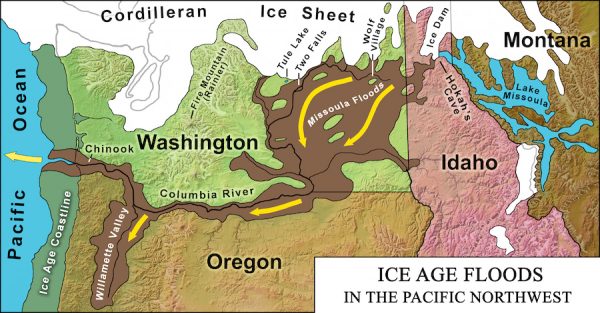
Every part of the cover addresses an aspect of life in those times. Glaciers flowing down from the Okanogan Highlands of Eastern Washington are no mere fancy. They represent the massive ice inundation that, in the Ice Age 14,000 years ago, blocked the flow of the mighty Columbia River and diverted it east and south to carve out the stupendous gorges of Grand Coulee. Vertical cliffs of layered volcanic rocks remain there to this day. They figure dramatically in the story as inhabitants desperately seek safety above floods a thousand times greater than anything seen in modern times.

Zeroing in on the center of the cover, the mammoth-hide tipis of Two Falls Village face certain destruction by an oncoming wall of water. The deluge will sweep away everything—and everyone—unless a hero can lead the people to safety.

Animals shared the fate of humans. Even titanic Columbian mammoths, the largest elephants of all, stood no chance against a wall of water many times their height. Other great animals would perish was well, from colossal short-faced bears, to giant ground sloths, to cave lions, to sabertooth cats. The last of these is represented on the cover by its likeness carved on its own fang, an amulet charm worn by the young hero Temokin and dedicated to his love, Denawe, who helped him overcome the snarling beast to which the fang originally belonged.

I’ll write more about the amulet, and the people and places touched on here, in my next post. Meanwhile let your mind soar over this dramatic scene, like Thunder Eagle at the top of the cover. What an awesome spectacle must have played out below him! Many villagers believed it was Thunder Eagle himself who set loose the deluge to clear evil, sinning people from the land. Only those of the greatest virtue would survive this ultimate test of nature.

Megaflood is available for pre-order and will be released on May 1, 2022. So, if a mystery/romance/action/adventure story suits your reading preferences, why not click over to Amazon, Barnes & Noble, Apple Books or other outlets and reserve your copy today? At $3.99, it’s $1 off the list price. You won’t be charged until the book ships, and you’ll be among the first to get it. Furthermore, by pre-ordering, you’ll help me make the day-of-release book sales more impressive to Amazon’s computers, which in turn will cause them to show the book to more potential customers. Thanks for your help, and I hope you enjoy the story!

Posted in Uncategorized | Tagged , , , | Comments Off on MEGAFLOOD – First Look at the Cover

A 14,000-Year-Old Murder Mystery

Talk about an exotic setting for a mystery! The desert cliff shown here was once a waterfall three hundred times the size of Niagara that roared with the entire volume of the mile-wide Columbia River. This rampart is just one of two great circular cataracts that existed in Eastern Washington during the Ice Age. Part of the second can be seen to the right.

People who lived here must have been in awe of its thunderous roar. Native Americans of a long-forgotten tribe had only recently crossed from Siberia into North America. And where there are people, can murder lurk far behind?

My latest novel, Megaflood, is set against this 14,000-year-old backdrop. And as if that weren’t dramatic enough, the Ice Age animals that lived alongside the people were equally stupendous. Giant pachyderms came in three sizes: huge (the Wooly Mammoth), colossal (the Mastodon), and titanic (the Columbian Mammoth), the last of which made an elephant look like a pup. And that’s not to mention the Giant Ground Sloth and the Short-Faced Bear, which were elephant-sized as well. Let’s see, did I leave out anybody? Oh. Yeah. How about ravenous Cave Lions and Sabertooth Cats? Me-YOW!

It was my task as author to bring all this astonishing science and history into focus while telling the tale of two young people, outcasts in this foreboding landscape due to their forbidden love. Fleeing a wrathful chieftain, they plunged straight into even greater danger.

This is one of my most ambitious books to date, weaving an intricate path from modern archeologists exhuming a body from a cranberry bog in Chinook, Washington, to an ancient saga where heroic characters move through a world of sweeping beauty and face perilous threats, all in true-to-life detail. Megaflood is available for pre-order and will be released on May 1, 2022. So, if a mystery/romance/action/adventure story suits your reading preferences, why not click over to Amazon, Barnes & Noble, Apple Books or other outlets and reserve your copy today? At $3.99, it’s $1 off the list price. You won’t be charged until the book ships, and you’ll be among the first to get it. Furthermore, by pre-ordering, you’ll help me make the day-of-release book sales more impressive to Amazon’s computers, which in turn will cause them to show the book to more potential customers. Thanks for your help, and I hope you enjoy the story!

Posted in Uncategorized | Comments Off on A 14,000-Year-Old Murder Mystery

Roly-Poly Dinosaurs

Here’s a fun one: a roly-poly armored dinosaur. As far as I know, no one has ever published a picture of this creature in its rolled-up pose—until now. If you don’t believe me, google “ankylosaur images” and see if you can find one like it. If you do, I’d be glad to hear about it.

I was researching ankylosaurs for my latest science fiction short story (more about that below) and the deeper I dug into the scientific literature, the more I realized the world’s paleontological experts had missed this concept entirely. In over a century of portraying ankylosaurs, no one has ever published an image of the animals rolled up like this. Yet I am convinced this trick came naturally to them, curling up for defense against Tyrannosaurus rex and other king-sized threats.

Modern day armored creatures do it. Armadillos, hedgehogs, pangolins, and even lowly pill bugs do it when threatened by predators. So why not the ultimate in armored creatures, the ankylosaurs?

The maneuver has an interesting name: volvation. It’s based on the Latin word volvere, to roll, and the concept that the animal rolls itself up into a ball. Some, like pill bugs or the Brazilian three-banded armadillo can roll up so tightly they offer nothing to predators except solid armored surfaces. I wondered if ankylosaurs could do the same, so I made these sketches to attempt to understand the possibilities.

As you can see, I found a way to arrange all the component parts of an ankylosaur into a pretty solid structure, especially in this second sketch, where the animal is locked down so tightly there are only armored surfaces to be seen. Click on the images for a closer look.

At this point I was pretty-well convinced ankylosaurs could carry off this maneuver if it was needed. But I wanted to dig deeper. I borrowed a skeletal diagram from a scientific publication and rearranged the bones from their normal walking pose to the rolled up one below. And everything fit.

So then, how was I to get word out about my idea?

I chose to gather all these images into one publication and offer a bonus to go with them: a short science fiction story I call “The Ankylosaur Adventure,” with a roly-poly ankylosaur starring on the cover along with some unfortunate humans. I followed the story with a discussion of the science that guided my creation of the artwork shown here. Finally, I added a bibliography of research articles that gave me insights into these intriguing creatures and their neat defensive trick—volvation!

P.S. The images are necessarily compressed in Kindle, Apple, and other ebook formats, lowering their resolution. They’re good at that size, but for higher quality images, I suggest the Smashwords pdf version, or contact me for even higher resolution images. I might even be compelled to present a guest blog or a live video conference on the subject.

P.P.S. A heads up on a separate subject: I plan to release another of my Northwest Tales novels in April. It features an Ice Age megaflood in Washington State, among the largest natural disasters the earth has ever seen! Stay tuned for more info.

Posted in Uncategorized | Tagged , , , | Comments Off on Roly-Poly Dinosaurs

The Way to a Dinosaur’s Heart

Jurassic Park's ducky Parasaurolophus

Is through his stomach, right?

Well, that may apply to T rex, but what about all those plant eaters? In my Dinosaur Wars books I always explore new possibilities for dinosaurian looks, behaviors, and… attitudes. For example, in the first two books, I introduced this odd looking creature, Parasaurolophus. It’s usually portrayed as a ‘harmless’ plant eater, but really? Was it so harmless?

Every year, hippos kill more people in Africa than lions. But they’re plant eaters, right? Yeah, they just happen to be big, foul tempered, and very bite-y plant eaters, that’s all.

Now, the Jurassic Park movies have chosen to present Paras as docile prey species, amenable to being roped and tied by pesky humans. Not so, Dinosaur Wars.Roping Para

I decided to dish up a big helping of bad-boy (and girl) for the Paras I portrayed in Dinosaur Wars 1 and 2. These beasties were described as kick-boxing ultimate warriors when it came to defending their babies–or any humans they had befriended–against all comers, including hungry T rexes.

But if you should develop a problem with a T rex, how do you get a Para to lend a helping hand, or hoof? Easy! Do what Kit Daniels did when a pair of Paras decided to build a nest on her father’s ranch and raise a brood of babies–she fed them! By throwing down some bales of hay from the barn, she not only earned the big animal’s trust, but their loyalty too. So when Kit and her boyfriend Chase Armstrong were cornered by a Rex, their Parasaurolophian buddies came to the rescue, pummeling the meateater with their hooved forefeet and bashing it with their hind legs, like gigantic kick-boxing kangaroos.

So Kit had made the best choice. Rather than trying to chase away her huge new neighbors, she made friends. And very big friends indeed. Friends like that come in handy when you’re living in the heart of Dinosaur Country.

Human to Para conversion table

Posted in Uncategorized | Tagged , , , | Comments Off on The Way to a Dinosaur’s Heart

Smashwords discounts my e-books in July

Just so’s you’ll know, Smashwords, one of my two book publishers, is having a month-long sale this July—that would be right now! Some titles are free, like my ever-popular novel Rainier Erupts! and my personal favorite short story, “A Dangerous Breed.” Other titles are half-off, so check them out on my Smashwords Author Page.

Even if you routinely use only Kindle, iBooks, or Nook, you can grab versions on Smashwords that are compatible with those devices, so don’t be afraid. Save that fear for gripping action tales like The Great Seattle Earthquake and The Smallpox Incident, which are participating in the festivities at 50% off.

Smashwords is the class act of independent publishing, so if you’ve never stopped by, now might be the time. One word of caution: check that the “filtering” pulldown on the righthand side of the menu bar is set to “exclude erotica” because Smashwords is pretty easy on authors of, shall we say, “naughty” storytelling? But with the filter on (it usually is) you won’t even see them. Ta Dah! You’ll still see bodice-ripping and pect-rippling romance titles, if that’s your thing, but nothing more tawdry than that.But I digress, given none of my books are in either category. On the other hand, if you want red-hot-action-adventures, medical thrillers, or laser-blasting science fiction stories, then you’ll want to take a fresh look at my titles while many are on sale.

And that about covers it. Happy reading!

Posted in Author, Northwest Tales | Tagged , , , , | Comments Off on Smashwords discounts my e-books in July

Eek! I dreamed up deadly mutant viruses long before COVID-19

Just as you get nice and immunized with COVID-19 vaccine, along comes a new terror—the viral variant! Deadlier strains of COVID are cropping up with alarming frequency. Such mutational shifts allow the new viruses to circumvent the immunity you acquired with your hard-won vaccination. So, are we doomed?

If it’s any consolation, this “variant” phenomenon is nothing new. Virologists have studied it for decades. Variants were first described among the influenza viruses of the great pandemic of 1918, in which they played a role in drawing out the pestilence for several years. And they’ve cropped up in every epidemic since. So even the frightfully named “Eek!” variant of COVID is not an entirely new concept.

But as we watch with dismay, this and other variants are arising around the globe with increasing frequency. So, it’s a cold comfort to know that they’re nothing new under the sun. Somehow, even the knowledge that humanity survived not just each new pandemic, but all the variant strains that piled onto previous plagues, is not entirely satisfying. Not when the virus threatens you and yours on a daily basis. Histories and statistics of mankind’s recovery from previous epidemics can’t help you shake the fear that, well, you might not be counted among the living when all is said and done.

So what’s this got to do with my fiction? Well, quite a bit, really. I anticipated this phenomenon in both of my epidemic novels, The Smallpox Incident and The Neah Virus. In each story, I laid out realistic scenarios based on my career-long studies of viruses and vaccines. My intent both times was to dramatize the social upheavals and desperate responses of medical and government agencies trying to avert catastrophe. Unsurprisingly to me, many events I portrayed have come true in the present emergency.

I also addressed the dire question, “Did this virus arise out of nature, or is it an escaped laboratory monster?” Without giving away too much let me just say, in one book the answer is “yes” and in the other the answer is even more unnerving. But one nice thing about fiction is that such questions can be examined carefully, and then answered clearly. No lingering doubts remain in the last pages of The Smallpox Incident or The Neah Virus. Don’t you wish life could imitate art in present circumstances?

Might I suggest you grab a copy on one or both of these now classic books, so you can read and reflect on the notion that nothing happening today is so terribly unheard of by scientists like me, who study viruses and vaccines? An added bonus is that my stories have relatively happy endings given the dire circumstances—and that’s the sort of outcome we all hope for in these trying times.

Posted in Uncategorized | Comments Off on Eek! I dreamed up deadly mutant viruses long before COVID-19

The Great Shakeout–Will Seattle’s Tsunami Chimes Ring?

I’ve a mind to drive downtown on Thursday October 15 at 10:15 AM and roll down my car window. I’d like to hear the sound of the tsunami chimes ringing out. Wouldn’t you?

Seattle, and the whole nation for that matter, is preparing for the “Great Shakeout” earthquake drill scheduled then. I’m registered to participate as an individual who’s ready to get “all shook up,” along with many Seattleites in all walks of life and diverse places of school, work, or what-have-you.

This year, I’ve picked out tsunami preparedness as my special area of concern. This comes in response to things I learned while researching my novel, The Great Seattle Earthquake, published last year. You see, when I looked into the idea of a major quake striking right underfoot on the Seattle Fault, I learned that, in addition to the trauma and loss of life that would come from such a natural disaster, the threat of a devastating tsunami has been pretty well established by recent scientific studies. So, that leaves me wondering, are Seattle’s emergency planners covering this possibility adequately, or at all?

My research left me, well, just a little worried that the answer is “kind of.” As I wrote a year ago, I found the tsunami preparedness plan for our two waterfront stadiums definitely less-than-adequate. Here’s a link to that older article. This year, I’ve been wandering around the internet trying to glean any news about an improved stadium plan, but so far I’ve found nothing at all. That’s a step up, in my opinion, because the old plan told people to calmly exit the stadiums, which might mean tens of thousands of people walking straight into an oncoming tidal wave. So, the good news is, I didn’t find any of that old misinformation in the present plans. I guess maybe my blog did some good, somehow. On the other hand, what I found was–nothing at all.

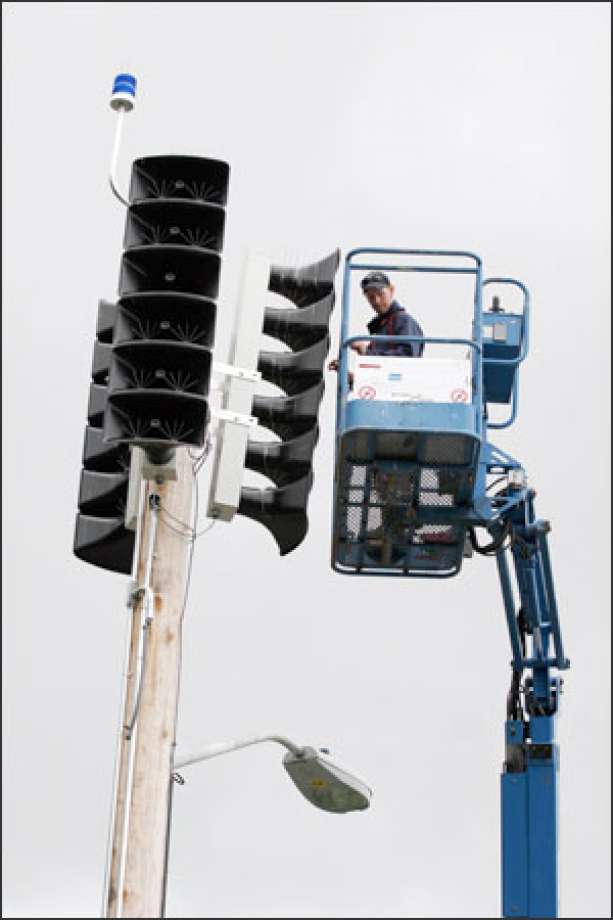
But I did find an old Seattle Post Intelligencer article from 2005 describing the installation of the waterfront warning system shown above. According to that article, this is what you’ll hear in an emergency:

“The first thing will be a tone that’s an attention getter so people will listen,” Steve Marten, project manager said. “We’ve chosen the Westminster chimes.”

“That will be followed by an actual voice that will give a specific message so that we can direct people to do what they need to do to get out of harm’s way.”

Hopefully, 15 years later, this system is still in operation and ready to deliver the message, “Run like hell for high ground!” But I haven’t found much information about it other than the old article. Let’s hope it’s currently in place and in the hands of people who are ready to deliver the life-saving message.

As I portrayed vividly in my novel, folks in the stadium area will have only a few minutes to make up their minds whether they’ll flee to safety–or die.

So, yeah. I think I’ll drive downtown Thursday morning and find out how well the system is working.

Update October 16, 2020: I did like I said and went down to the waterfront and listened as 10:15 came and went without a sound. I stood there on Ivar’s Pier 54, staring at the Fireboat Leschi, which figures so prominently in The Great Seattle Earthquake, moored next door at Fire Station Number Five. I noticed that the alarm speakers shown above had been removed. But I can’t help but wonder. In the event of a quake on the Seattle Fault, those loudspeakers would be lifesavers. So, where did they go?

Posted in Uncategorized | Comments Off on The Great Shakeout–Will Seattle’s Tsunami Chimes Ring?

I Dreamed the Bridge Fell Down

This photo of the West Seattle Freeway Bridge shows you two things: 1. It’s a marvel of modern engineering, a huge construct of reenforced concrete that crosses the Duwamish River in a single arching high-rise span. 2. It’s empty of cars, trucks, or even a bicycle.

That’s what happens when such a modern marvel suddenly develops a profusion of cracks at mid-span, threatening to plunge the whole thing into the river along with any vehicles and people unfortunate enough to be crossing at the time.

So it’s closed for repairs, or for demolition, if repairs can’t be made solidly enough to guarantee public safety. This closure has altered the commute from West Seattle to downtown from easy compared to other commutes, to a routine nightmare for those needing to cross the river daily.

So what’s all this got to do with me and my novels, you might ask. The answer is pretty simple: I predicted the demise of the West Seattle Bridge in The Great Seattle Earthquake. I dramatized just what it would be like if you were driving across the bridge when disaster struck. A scary ride, to say the least, with your survival in serious doubt. And all this written several years before anyone noticed that the bridge had begun to develop cracks at midspan–for real.

Now, I don’t claim to be clairvoyant—just a thorough researcher when getting background information for my stories. But this isn’t the first time my fiction has touched upon things that later became fact. This sort of prognostication seems to be a hallmark of my writing these days. My publisher’s website describes me this way: “Thomas P. Hopp routinely imagines the unimaginable.” And that’s definitely true in this case. No one had seriously considered what might happen if the bridge split in the middle and fell—no one except me, it seems.

While researching my stories, I tend to uncover obscure factual details that stimulate me to think through the worst-case scenarios. I portray these in my stories and let the reader follow characters whose lives are shattered or at least radically altered by the new threat. The Great Seattle Earthquake is the latest in a series of disaster novels—natural or otherwise—that I’ve published. Previously, there was Rainier Erupts, in which the characters will either live or die depending on minute-to-minute—or second-to-second—decisions made when our local mega-volcano blows its top. Then there’s my medical thriller, The Neah Virus, in which a brand new virus arises out of nature to spread contagion and death, precipitating a desperate quest for a vaccine. That ought to sound familiar. In The Smallpox Incident, the viral nemesis is a laboratory creation of bioterrorists. Does that sound like fears being voiced about COVID-19? For me, none of these ideas are new. I’ve thought them through and published them years ago.

Click the links if you’d like to learn more about my stories. Given the darkness of our times, you’ll be happy to know I tend to follow survivors, not victims. And I’m an optimist who avoids apocalyptic doom and gloom. I try to offer good, scary stories for these tough times, with positive outcomes and even some happy endings scattered amid the wreckage.

Posted in Uncategorized | Tagged , , , , | Comments Off on I Dreamed the Bridge Fell Down

Eerie parallels: COVID-19 & my medical thriller The Neah Virus

When I released my novel The Neah Virus back in 2013, there was little reason to suspect I was writing about issues we’d all be facing in 2020. But here we are, locked down–some of us–and hearing daily of a deadly nemesis that apparently arose among wild animals and made the leap from them to us. With horrendous consequences. And no end in sight (though as a vaccine researcher, I’m optimistic a cure is around the corner).

In my book, a virus emerges from nature at Neah Bay, a small Native American reservation town at the northwest tip of the Olympic Peninsula here in Washington State. People start dying. Contagion is rampant. The Centers for Disease Control calls for desperate measures, including quarantines that require the National Guard to intervene in the interest of public safety. Does any of this sound familiar?

Want more parallels? The virus in my story is a mutant, an altered form of the already deadly rabies virus, changed into an even more lethal and fast-spreading form. Sound familiar?

This is the sort of thinking that wakes me up at night and gets my fingers flying over the keyboard. Given my history of working on vaccines and immune-system hormones over an entire scientific career, I suppose it’s not too surprising. But with that background, when the imagination gets into overdrive, I come up with some pretty scary stuff. Scary to me, let alone an unsuspecting reader.

Consider this short excerpt:

“Once you’ve read the virus’s code, how many days will it take to make a vaccine?”

“The same rules apply as for other viruses,” McKean said gravely. “It takes months to produce each year’s influenza vaccine, and that’s a virus we have a lot of experience with. Given an unknown virus like this, it might take years to create a new vaccine.”

“Years! Isn’t there a shortcut?”

“We could try producing the virus’s surface protein in a bacterial culture—a subunit vaccine. That might be accomplished in weeks or months.”

“But that might be too late for us, if we’ve been exposed.”

His expression darkened. “Kay Erwin told me this morning the number of people with symptoms like Pete Whitehall’s has grown to eighty. That’s enough to convince me the virus is dangerous, even if the CDC still isn’t sure. How have you been feeling, Fin?”

End quote. Now, that’s what we’ve been hearing about the coronavirus–months to years before we have a vaccine. Yikes.

But here’s a nice thing about fiction: if the writer insists on a happy ending (or at least a non-lethal ending) then that’s what you get.

Here’s a link to more information about The Neah Virus if you’re interested.

Posted in Uncategorized | Comments Off on Eerie parallels: COVID-19 & my medical thriller The Neah Virus

Formulating COVID-19 Synthetic Vaccine Doses

This is my third and final post describing a COVID-19 synthetic vaccine. Future posts will return to the usual fare of books, stories, and anecdotes. But this last serious post wraps up a full disclosure of how to make a COVID-19 vaccine, so here goes.

The thing is, you can’t just make a vaccine. You have to inject it, and it has to immunize. So the last step in this process is called formulation. I’ve formulated injectables for–let’s see–about 47 years now, so I ought to know how. Shown at left is a photo of the most recent vaccine I worked on, an anti-cancer vaccine targeting the hormone hCG (there are links below for more information about it).

But before I get into formulation details, let me show you just how well these vaccines work. The graph at right shows an hCG synthetic-peptide vaccination (black arrow) that raised high levels of anti-cancer antibodies within just three weeks and increased by a thousand-fold a few weeks after that. High antibody levels persisted for six months and probably lasted more than a year, though the experiment was ended before that. The two white insets show ISMS (injection site macro-pathology scores) at or below 1.0, which the FDA defines as very little ouch going on. Wouldn’t you like to be protected for six months to a year from COVID-19 right about now? I know I would. By next year, COVID-19 may have done its damage and disappeared, only to be replaced by some new threat coming along. No worries though, we can always make a whole new synthetic peptide targeting the next microbe in three days.

All vaccines are formulated with some added materials (adjuvants) that aid the immune response by creating a depot of material that stays at the injection site for weeks or months. All the while white blood cells come and go, getting more and more riled up and producing more and more antibodies. There are dozens of formulation components out there, and most immunology labs have some on hand. I’ve used quite a number of them myself. Things like alum, squalene oil, gels, and mineral powders, plus immunostimulants like muramyl dipeptide or cytokines thrown in for good measure. It’s a bit of a grab bag of possibilities, but most immunology labs have these things or can get them. The slowest step is to test them in a quality assurance (QA) program to guarantee their safety–but what I’m talking about here assumes you’ve already got the materials certified clean and ready-to-go.

So let me be specific here, because there are many ways to do things wrong, and only a few ways to get the right blend of immune-enhancing ingredients. Here’s my favorite formula (you can skip this part if you don’t have a PhD in biochemistry):


  1. Solid immunogen
  • Peptide-DT conjugate: 0.5 grams
  • Calcium sulfate hemihydrate: 2.0 grams
  • Dextran sulfate (Na): 0.15 grams
  • Water: 1.5 grams (ccs)

Mix these to a thick suspension, dry to a solid block, grind to a fine white powder, sieve to 45-to-150 micrometer particles.


  1. Water-in-oil emulsion

Suspend the fine powder in saline containing 0.125 mg/mL nor-muramyl dipeptide (an immunostimulant). Combine two parts of this with three parts of emulsion oil (squalene + mannide mono-oleate 4:1) and mix vigorously. Your vaccine emulsion is ready to inject!


That wasn’t so bad now, was it? Many vaccine labs have the chemicals and equipment on hand to do this. The next step is animal testing by immunizing white rabbits or mice. These doses can be prepared quickly as shown below, where an emulsion is being made by pushing back and forth between two syringes until your thumbs ache.

For human dose preparation, industrial emulsion-makers, large-scale sterile facilities, and other quality-control techniques are required. No one wants to give a dose of one microbe while protecting against another.

So there you have it. We’ve made our peptide conjugate, mixed in our favorite adjuvants, and now we’re ready to vaccinate a lot of people. The benchtop recipe above could dose five to ten thousand people, and the process can be scaled up to industrial strength for hundreds of thousands or millions of doses. But in the short term, wouldn’t it be nice to use smaller batches to protect hospital staff from getting or giving the virus, as well as first responders and other at-risk people? With this vaccine, all of that can happen within a timespan of a few weeks to a few months, depending on whether you take a little time off to sleep. Given the viral threat hanging over us, who’s really sleeping all that much these days anyway?

Please don’t let the conversational tone I use here fool you. I’m quite serious about this vaccine. Deadly serious, given COVID-19 is out there killing people and this vaccine could be saving lives right now. It’s just that I’m retired and don’t have a laboratory of my own. It might take me months-to-years just to find a funding source and begin operations. On the other hand, there are many organizations around the world that have the right facilities and personnel to make this happen.

My task is finding them and convincing them to give this method a try. Wish me luck.


Below are links for more detail on this kind of vaccine. If you wade through the data in links 2 and 3, you will see that my colleagues and I have made this type of vaccine work in humans before.

  1. First, a link back to my previous COVID-19 postings on my blog site. You can learn a lot about my scientific background by visiting my home page and wandering its links (contact info too).
  2. An old business plan for CG Therapeutics Inc., with details of our cancer vaccine clinical trials (a large pdf, give it time to download).
  3. An old slideshow on CG Therapeutics’ technology with even more vaccine details (a larger pdf).

I have even more information, including a full IND (Investigational New Drug) application that I helped prepare for the now-defunct CG Therapeutics. It wouldn’t take long to repurpose that 319-page document to present this COVID-19 vaccine to the FDA. Any takers?

Posted in Health, Real Science | Comments Off on Formulating COVID-19 Synthetic Vaccine Doses