Swimming and Flying on the Moon

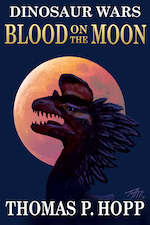
Blood On The MoonPeople talk about colonizing the moon but they always focus on the boring details of habitats, supplies, and transportation. Here’s something a little more fun. What about a lunar swimming pool? How about flying by just flapping your arms? There are some truly dream-like experiences waiting for us when we finally get there.

In Dinosaur Wars: Blood on the Moon, in between bouts of warfare and political intrigue, I’ve taken the time to imagine and write down what it might be like to visit a lunar hotel that is equipped with the basic facilities for pleasant diversions: cabana bars, a swimming pool, a high dive, and even the uniquely lunar ability to fly under your own power. Here’s an excerpt from the book in which the young heroes Chase Armstrong and Kit Daniels visit such a place:
– – – – – – – – – – – – – – – – –
One dome-shaped building among the many edifices that covered the floor of Phaeon Crater was dedicated to recreation. Called Akanna Neesta, or Pleasure Palace, by the Kra, it was fully arrayed with attractions on a magnitude as great or greater than the finest resorts humans enjoyed on earth. Its central atrium was a huge circular dome with a glass ceiling affording a view of millions of stars overhead in the black lunar sky, as well as Illik Base’s central pyramid looming on one side. A ring of immense lighting panels lit the place like a sunny day on earth. The air had a steamy quality nearly as humid as a Roman bath. Tropical palm trees growing to full height ringed the space, which was larger than the largest domed stadiums on earth. Attractions and diversions abounded beneath the overhanging fronds. There were courtyards where Kra played ball games or, being carnivores, participated in mock hunts of prey that they consumed at the end of the event. In the middle of the dome was a huge blue swimming pool with an irregular curving outline, punctuated by thatched cabanas serving food and drinks. On one side of the pool, a quartet of Kra musicians and singers squatted on hassock-like seats and performed a song that contrasted with the warlike drum-driven chants the three humans had heard in the Temple of Death at Arran Kra. This music was more melodic and harmonic, accompanied on a pair of small tabla-like drums, a flute, and a stringed instrument shaped somewhere between a guitar and a banjo. Although the singers intoned a peaceful sounding melody, nevertheless their distinctive Kra vocalizations had a raucous, crow-cawing essence. They sounded much like the backup vocalists on John Lennon’s classic “Tomorrow Never Knows,” to which the entire composition seemed melodically and rhythmically related. Opposite the singers a high prominence of native moon rock jutted up from the floor as though it might have been a remnant of Phaeon Crater’s central peak. This prominence had been modified by the Kra to provide a waterfall, a water slide, and a high dive for the entertainment of the dome’s visitors. Water cascading from the brink of the fall descended in slow motion in the low gravity of the moon and churned up waves where it hit the pool’s surface that propagated outward in slow-moving concentric rings.

“Nowhere but on the moon,” said Chase, watching the water with amazement. “Even waves move in slow motion.”

“Naturally,” replied Dr. O. “The speed at which a wave on water propagates is directly proportional to the pull of gravity. The less gravity, the taller the wave and the slower its motion.”

“I hear what you’re saying, Doc,” Chase agreed, “but I had to see it to believe it.”

A pair of small, bright-green-bodied and orange-headed pterodactyls flew past them and soared up to land high on the trunk of a palm tree, hanging on by all fours and screeching like parakeets.

Not far from where Ogilvey, Chase and Kit stood, Gar and Gana had settled down at a poolside table, squatting on hassock-like, back-less leather chairs, typical Kra furniture. They were talking quietly about the object that Gana had brought with her and placed on another smaller table at her right hand. This was a portable incubator shaped like an Easter basket, in which she’d placed their precious egg.

Ogilvey murmured, “It’s good to see that Gar is taking Gana’s revelations regarding Saurgon’s overtures in stride, or is at least keeping his thoughts to himself. There is much at stake diplomatically and anger would only inflame the differences at a time when agreement is what is needed most.”

“Right now,” said Chase, “I’m more interested in taking Saurgon up on his offer for us to go swimming. What do you say, Kit?”

Within minutes Kra attendants had provided specially made bathing suits that had been prepared in anticipation of their arrival. After changing their clothes in cabines available at poolside, Kit and Chase walked partway up the central peak and stood at the top of the high dive.

“I don’t know,” Kit said edgily. “It’s got to be a good thirty feet down.”

“C’mon,” Chase urged. “It’ll be a slow motion fall.” He took her hand, stepped to the edge of the diving platform and said, “One, two, three, jump!” They stepped off the platform in unison and plunged down toward the pool’s surface in what was indeed a slow-motion descent. They hit the water feet first, splashing up walls of white froth that shot far out to each side of them and rained down gently on the pool’s surface. They submerged in the warm water but easily rose to the surface in time to watch the tall waves they’d made spreading slowly and gracefully outward from their landing spot.

“Whoo-hoo!” Kit cried. “Let’s do it again.”

“Okay,” Chase said, hugging her as they treaded water easily with slow kicks. “But I want to get on that water slide too.”

“Look, up there!” Kit exclaimed, pointing at a Kra who’d climbed to the highest pinnacle of the rocky hillock and stood on the craggy summit that was easily fifty feet above the water’s surface. The Kra stood poised for a moment and then launched itself into the air like an Acapulco cliff diver. It fell gracefully downward, headfirst in a swan dive, but just as it was about to hit the water’s surface, it gave a strong flap of its wings and despite the apparently insufficient length of its wing feathers—it flew!

Dr. Ogilvey, who’d come to the edge of the pool nearest Kit and Chase, called out, “Another advantage of low gravity. Even stubby Kra wing feathers are sufficient for flight.”

The Kra, rather than touching down on the water, flapped vigorously and rose high into the air of the dome. It followed a leisurely course around the upper reaches of the dome for several minutes and then returned to land on the same pinnacle of rock from which it had started its sojourn in the air.

“I’d love to try that!” Kit exclaimed.

Gar called a few words to Dr. O, which the professor translated. “According to Gar, that can be arranged.”

Within another fifteen minutes, both Chase and Kit had been fitted out with artificial wings made by attaching real Kra feathers to mechanical apparatuses that fit on each arm, approximating the mechanical wings of the legendary human flyers, Icarus and Daedalus. As they stood at the brink from which the Kra had flown, Ogilvey called up an explanation. “When the Kra pluck their wing feathers for war or other necessities, they substitute these artificial wings for their real ones. Go ahead, give them a try!”

Without hesitation, Chase dove as he’d seen the Kra do, plummeting in slow motion until he turned upward with a few vigorous flaps, gaining altitude. “Come on,” he called to Kit. “It’s great!”

She stepped to the brink and voiced a nervous, “Geronimo!” and then leaped into the air. She fell until she duplicated Chase’s feat of flapping upward just before reaching the water. Suddenly, they were flying together like a pair of birds, or like the pterodactyls they’d watched a few minutes before. The feeling of moving freely in the air, propelled only by the movement of one’s own arms, was indescribably wonderful. It was only after several minutes of briskly flying to and fro around the dome’s interior, that a sense of fatigue in muscles never before used for this purpose brought them both back to land on the pinnacle. They were tired, panting, but delighted almost beyond measure. “Only on the moon,” Kit said, concurring breathlessly with what Chase had said earlier.
– – – – – – – – – – – – – – – – –

For more cool moon imaginings, you might like reading all of Dinosaur Wars: Blood On The Moon.

Posted in From Outta Space | Tagged , , , , | Comments Off on Swimming and Flying on the Moon

Edwin Charles Hopp 1925-2012

Ed in printer's apronAuthor’s note: My father, Edwin Charles Hopp, died on October 27, 2012 after a stroke. He passed peacefully at age 87 with family and hospital staff watching over him. Through his difficult last days, he never expressed anger or frustration to anyone. He died as he lived, sweetly.

THE LITTLE FINGER OF MY FATHER’S LEFT HAND

By Thomas P. Hopp

The little finger of my father’s left hand. Most people consider it the least of their fingers. It’s the pinky, the baby finger, the one least able.

Not so with my father. Although he was right-handed, the last digit of my father’s lesser hand had an uncanny power in it. It was a source of great emotional and physical movement when he brought it down on the keyboard of a piano. Then, it took on a force far beyond its endowment. It had the ability to make people move, to make them dance and sing, and shout, and applaud. It embodied an almost supernatural capacity to make people forget their sorrows and pains and frustrations, to live in the moment, to allow joy to overtake them, body and soul.

Hep HoppEdwin Charles Hopp studied piano for a dozen years as a child and as a teenager during the depression years of the thirties and the war years of the forties. He learned both classical and popular tunes but found his greatest forte in pounding out the feverish rhythms of the boogie-woogie tradition. He developed an exceptional ability to deliver the great bluesy barrelhouse sounds of the likes of Pine Top Smith, Meade Lux Lewis, Jimmy Yancey, Pete Johnson, and Tommy Dorsey. He culminated his skills with mastery of the incredible boogie magnum opus, Jack Fina’s “Bumble Boogie,” a hyper-rhythmic reworking of Rimsky Korsakov’s already frenetic “Flight of the Bumble Bee.” To hear Ed Hopp play it was a transfixing, transfiguring experience.

In boogie style, the initial low tonic note of the bass line is sounded with the little finger of the left hand, often followed by the thumb of the left striking the octave. This strident bass figure is the essence of the eight-beats-to-the-bar boogie-woogie rhythm that makes it one of the most danceable of all musical forms.

When my father sat down at the piano and his left pinky sounded out that first clear and compelling note of the bass line, amazing things would follow. As his hands moved forcefully over the keyboard, his left would finger the pattern of one or another boogie bottom, while his right would contrive melody lines that were themselves rhythmic commands to tap a toe or get up and move to the music. Whole rooms full of people would rise and jump and shout when Eddie Hopp brought the eighty-eight keys to life.

I recall myself as a child, crawling around the living room floor in time to the strident beat of “Bearcat Strut,” while my father practiced his piano alone as he did most afternoons before going to work the swing shift as a printer. No doubt he took some fatherly satisfaction in my movements, inspired by his evocation of the mysterious creature. On other occasions, I can recall one or another of his grandchildren, scarcely able to walk but bobbing a head to the irresistible beat.

When family and friends gathered at our home, or when he found himself urged to sit at a piano in some bar or clubhouse, Ed would pound out that sure and steady rhythm and couples would begin to dance the jitterbug to the cheers of onlookers and listeners focused on the mesmerizing beat. The time to party was never far off when Ed Hopp and a piano were together in the same place. In his prime, he could literally make the piano bounce. Entire rooms would ring with music and cheering voices.

In the last days of his life, when the stroke had come and the ability to speak had left him, there was little to do but wait for his next dose of morphine to ease pains that had developed in his legs. But the last capable part of his body was that left hand. Lying in his bed, he would point to people or things with it to make his thoughts known by nodding yes or no when asked if his message had been understood.

He would hold out that left hand flat and flutter it like a leaf in a breeze to indicate that he was too cold. He would hold it out with thumb tip and index fingertip circled and pinky high to indicate that his warm blankets had been snugged up just right. And he would hold out that left hand for us to shake as his sign of gratitude for our help and concern, or to say goodbye when a visit was coming to an end. The little finger did its part then, clasping along with the other fingers, pressing the other person’s hand firmly, gently, and fondly.

One morning, he just didn’t wake up. To the very end though, there was love and warmth and feeling–and uncommon strength–in the little finger of my father’s left hand.
###

Posted in Author | Tagged | 4 Comments

Dinosaur Wars Three — Published!

Blood On The MoonThe Blood Moon rises, and war is on the horizon! But it’s good news for moon watchers and dinosaurophiles alike! The third book in my Dinosaur Wars series is available in ebook format at all the major bookstores. This story completes the Dinosaur Wars trilogy and answers all of the outstanding questions that built up along the way. For instance:

Just what is that awesome death beam blasting from the moon? Can it ever be defeated or will it keep roasting us poor earthlings?

What’s to become of the young heroes, Chase Armstrong and Kit Daniels? Will they survive another T rex attack? Will they find love?

And what’s up with Gar the Kra, Kit and Chase’s dinosaurian ally, and his mate Gana? Will they ever be reunited? Will their unhatched egg survive the rigors of war?

If you’d like to know the answers to these and a dozen more questions, have a look at Dinosaur Wars: Blood On The Moon. Trust me, your curiosity will be satisfied.

And while you’re at it, consider these other minor but intriguing questions. What would it be like to dive into a swimming pool on the moon, falling in low gravity and splashing up slow-motion waves? Could a person put on wings like Icarus and actually fly through the air of a moonbase’s pleasure palace? Read and find out.

As always, I’ve tried to combine exciting action of a military and a dinosaurian nature with personal stories of struggle, achievement, and romance. That’s quite an ambitious mix but I’ve done my best to capture it all in words.

You can find Dinosaur Wars: Blood On The Moon versions for Kindle, Nook, iTunes, Kobo, Sony Reader, as well as other formats at my publisher Smashwords website. Some of these may not be available for another week or two, but some are there right now. Stop by this blog and let me know how you like the story, or say hello on my Facebook page.

Happy reading! Dinosaur Wars: Blood On The Moon is suitable for all ages. It can be read by itself or as part of the series, take your pick.

Posted in From Outta Space | Tagged , , , , , , , | 4 Comments

The Giants’ Graveyard

Tombstones and totemsIt’s the spooky season. That makes it the right time to visit one of Washington State’s eeriest places. Giants’ Graveyard, anyone?

Out on the windswept, chilly coast of Washington’s Olympic National Park lies a place that is at once captivatingly beautiful and just a bit scary. On an altogether remote stretch of Pacific Ocean shoreline lies a haunted place said by the elders of the Quileute Tribe to be the graveyard were giants were laid to rest in ancient times, a place where huge tombstones and totems dot the ocean’s surface just offshore; a place of spirit, a place of grand spectacle, a place of ghosts.

Tree stacksTo even get a glimpse of this realm, a person must hike through more than a mile of deep forest that is itself a place of brooding spirits. Stumps of titanic trees felled by pioneer loggers still stand as testimonial to the times when the quest for profit and the quick buck brought the majestic hemlocks, cedars and Douglas firs down by the thousands. Those times brought plagues of smallpox and measles to the natives and depopulated whole villages in the mid-1800s.

Since then, thanks to the imposition of the coastal strip of the Olympic National Park under the direction of President Franklin D. Roosevelt, the land has begun to heal and the headlands along the shore sport tall stands of regrowing evergreen forest.

If you choose, as Shelley and I did, to hike not just to Third Beach where the sea stacks of the graveyard can be seen in the distance, but instead to go overland past a promontory that is impassible on its seaward side, you will come to a cove that looks directly out on the monolith-strewn bay. It’s a truly astonishing sight to see so many titanic towers of rock, washed at their bases by huge ocean rollers casting white foam high.

Sitting on a driftwood log on that remote beach, it was easy to get the creeping feeling that we were not as alone as we might think. Certainly, the beach was devoid of people. But spirits? It would have been imprudent to think that there were no echoes of ancient life in a place so dense with atmosphere, so dramatically endowed with signposts of something more, something as restless as the sea, something beyond common experience.

My motivation for the trip was to get some detail for describing several scenes in my upcoming novel, Dinosaur Wars: Blood On The Moon. I got that and more. The solitude, the grandeur, and the eeriness will stick with me for a long time. I’m still just a bit spooked.

Posted in Author, Indian Country | Tagged , , , | Comments Off on The Giants’ Graveyard

Devil Dogs

A Dangerous BreedEver wonder what would happen if a pack of weirdly mutated half-coyote dogs went on a rampage using human intelligence spliced into their genes? What if they had an unquenchable thirst for human blood? What if they used humanity’s most deadly weapon against us — namely OUR MINDS!

If you’ve never read one of my Peyton McKean mystery stories, maybe this spooky season is a good time to give it a try. The short story, “A Dangerous Breed” is a great place to get an introduction to Peyton and his buddy Fin Morton, who have their hands full with this mystery. The question is, will they find an answer to what has gone horribly wrong with these doggies, or will they end up as lunch?

Click the image of the “Death’s Head Bitch” for a closer and creepier look.

While there’s been yet another delay in the release of my third science fiction novel, Dinosaur Wars: Blood On The Moon, that book is coming along at its own pace, as I’ll explain next week.

Meanwhile, for a good seasonal chill down your spine, I’d highly recommend you check out “A Dangerous Breed.” You can learn more about it here, or chase it down at your favorite ebook retailer.

Posted in Author, Indian Country | Tagged , , , | Comments Off on Devil Dogs

Got it covered!

Blood On The MoonThe new Dinosaur Wars book isn’t quite ready for publication yet but at least it’s got a cover. My vastly talented team of artists have come up with what ought to be an award-winning piece of cover art. That’s Gar the Kra looking both dapper and dangerous with his battle armor, wing feathers, and super-sharp aseeta knife. In the background is an actual NASA photo of the moon in eclipse, showing off its eerie blood-on-the-moon look.

Might I suggest that if you haven’t read books one and two of the series, you’d be well advised to download a copy of the first book, Earthfall. It’s still available for FREE for a while longer. That’s a nice price.

Posted in Author, From Outta Space | Tagged , , , , | Comments Off on Got it covered!

Still at it

The details involved in getting a book out are legion. Not long now though.

Posted in Uncategorized | Comments Off on Still at it

Dinosaur Wars 3, done again!

Just a quick note this week. I’ve been pushing hard to get the second draft of the third Dinosaur Wars book done, and I’ve gotten just a bit obsessive about it. There’s something about grinding through 95,000 words that tends to make an author get that way. A typo here, a comma there — and there and there and there and there and there — and pretty soon you just go all bleary eyed.

But it’s done at last and in the hands of my reviewers, who promised to get right to it.

Meanwhile, I’ll turn my attention to the cover art and other publishing matters, and if things go as planned, this baby will be out as an ebook before the end of September. I sure hope so, because my head is already filling up with ideas for another story or two — or three or four or five or six.

Posted in Author, From Outta Space | Tagged , , , , , | Comments Off on Dinosaur Wars 3, done again!

Neil Armstrong, Chase Armstrong’s namesake

Astronaut ArmstrongGodspeed, Neil Armstrong. Your name will live through history. And it will live in my stories.

When I was searching for a name for the young hero of my Dinosaur Wars stories, I wanted to find a name that would speak of adventure, of quests, and of excellence. Through a long process of experimentation and elimination I ultimately arrived at Chase Armstrong. I’d gotten comfortable with the first name, because Chase certainly evokes the process of seeking and following that the hero undertakes in a quest. But the last name had eluded me. I’d tentatively settled on Chase Anderson, because the name had a good ring to it and seemed like it ought to belong to a fellow out of the heartland of America, a park ranger no less. It had a pretty good, wheat-bread nicety to it that I liked for a good-guy adventurer, but the Anderson part (forgive me all Andersons) didn’t immediately add any of the larger-than-life dimensionality that I was looking for.

While pondering Anderson, Anderson, Chase Anderson, I suddenly heard myself saying Armstrong, Chase Armstrong, and I was immediately certain I’d found the name I sought. I was one of those who sat and listened to Neil’s voice from the moon as he took that one small step, so I instantly knew I’d subconsciously thought of Neil Armstrong. An instant after that, I thought it was a bit cheeky of me to think my humble fiction writings were significant enough to attach to such a famous namesake. But that hesitation only held me for a moment.

Completing the questNo, I thought, that’s exactly it. Neil was known among astronauts for his humbleness and hard work, and for his sharp reflexes under pressure. Neil was exactly the kind of person I had already crafted my hero into. Therefore attaching the famous name was no aberration.

In recent decades, the personalities of story heroes have been trending on a downward arc. They’ve become too complicated, too maladjusted, too negative, and in many cases just too brutal to truly be called heroes. But the hero I had set out to craft was a young man capable of great feats who lives a modest, hard-working lifestyle until events outside his control draft him into an adventure at the limits of human capability. That is the essence of the heroic personality. That was the essence of Neil Armstrong, and now it is the essence of my story hero, Chase Armstrong.

Names, like people, can have more than one dimension, especially in fiction. A few seconds after I’d decided that Armstrong would suit my character well, it occurred to me that the name has deeper meaning. Arm Strong. Strong Arm. There’s a good metaphor in it, the notion that a flight to the moon requires a strong character, and one whose arms have the strength to persevere, as when Neil took control of the lunar lander from its guidance computers to avoid a hazardous field of boulders and landed the craft manually. To do the job he needed, if not strong arms, then at least a steady hand on the controls.

In my stories, Chase is indeed a man of strong arms. Not only does he physically battle with dinosaurs on several occasions, but he uses the other type of arm, a rifle, with deadly skill.

But not everything a man does with strong arms involves conflict. Chase’s last name also suits his other role, that of lover. In his budding relationship with Kit Daniels (the genesis of her name will be told another time) Chase’s arms are called upon again, this time to hold Kit tenderly yet powerfully when the two of them embrace. He’s the kind of man who can literally use his strong arms to sweep a girl off her feet and Kit, female through and through, can’t help but be impressed by his sheer animal power.

Finally, I see there’s some sort of full-circle phenomenon in the outcome of the Dinosaur Wars trilogy in book three, Blood On The Moon. For in the course of tying up all the loose ends of the two preceding novels, I found myself compelled to write Chase Armstrong into the same trek that Neil took. In order to complete the saga, Chase has to trek across that same quarter-million mile distance Neil pioneered, in order to restore peace and happiness here on earth. Chase Armstrong’s hero’s quest therefore leads him on exactly the same odyssey first explored by Neil Armstrong.

So, Chase Armstrong is the right name for my hero. Neil, wherever you are in the vast cosmos, I hope that pleases you.

Posted in From Outta Space | Tagged , , , , , | Comments Off on Neil Armstrong, Chase Armstrong’s namesake

Tla-Ook Canoes

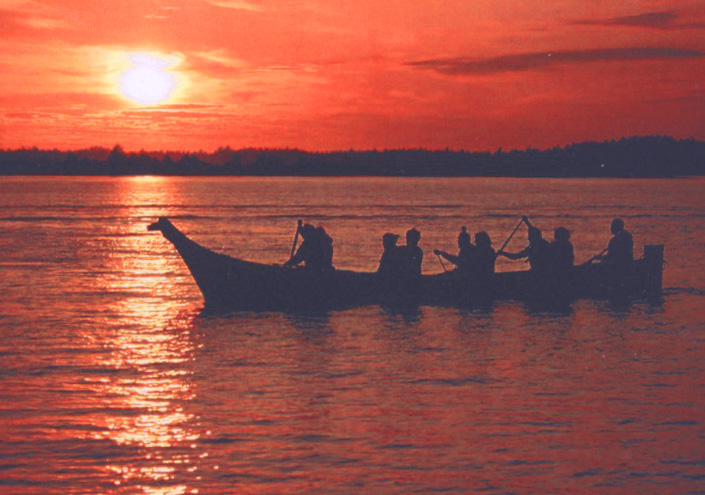
Sunset paddlersSeveral weeks ago I mentioned canoeing on Clayoquot Sound in a native dugout. Let me elaborate.

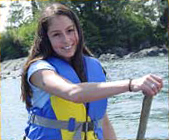
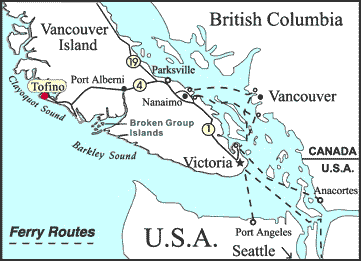
Tla-Ook Cultural Adventures is a small operation in the town of Tofino on the Clayoquot Sound on Vancouver Island, British Columbia. When Shelley and I arrived at the pier, we were pleasantly surprised to find that we were the only customers that day and the canoe, and its charming skipper Gisele Martin, were all ours. Gisele gave us each a life vest and a wooden paddle and got us into the canoe, which was a traditionally carved cedar dugout. We set off into a calm and pleasant afternoon paddling hard against an incoming current. This tour definitely proved to be a participation activity, and not a haven for slackers or anyone out of shape.

Skipper Gisele MartinAs we pulled hard against the current, Gisele helped us along with a native song, sung low and rhythmically from her position at the tiller in the stern. The song, she explained, was a means to synchronize the strokes of the paddlers, and also served to notify other tribes in times past, exactly who was approaching their shores. This in turn maximized the turnout of friendly greeters when a village was neared, and minimized the threat of the canoe being met by an angry war party. Canoers with bad intentions apparently didn’t sing as they stealthily plied the waters of the coast.

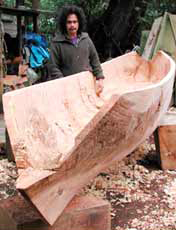
Joe Martin with canoe under constructionThe canoe, carved from a single cedar tree trunk by Gisele’s uncle, Joe Martin, was heavy and required a bit of muscle to get going, but it also was quite stable and carried forward nicely on its own momentum once it was up to speed. We got around the Sound quite a bit, moving from island to island among the many that dot the waterway, with Gisele pointing out wildlife and telling stories about the islands, each of which was the object of one or more traditional tales that Gisele was happy to share.

There had been a great battle here, a grand potlatch there, the otters played on this shore, the bald eagles fished from that tree… the stories were many, and each one enchanting. In the lore of the Nuu-chah-nulth nations, of which Gisele’s Tla-o-qui-aht people are one tribe, every place and every type of animal has its legend. As we paddled around the waterways, Gisele told many of these stories, and each had its charm.

Equally engrossing but naturally much more somber, were tales of contact with Europeans and European Americans, which occurred during the last stages of colonization of Western North America in the 1700s and 1800s. When a village was bombarded by an American warship, villagers took revenge on the next ship to come their way, attacking and sinking the American gunboat, Tonquin, in one of the most mismatched naval encounters of all time. When the bloodletting was done, many of the canoe warriors were dead, but the Tonquin lay on the bottom of Clayoquot Sound.

Another harrowing tale was the local version of the horror story of the arrival of smallpox among people who had never experienced the plague before. As ninety-five percent of Nuu-chah-nulth people lay down and died, a wise old grandmother by the name of Tla-Ook insisted that her family all flee to a small cove far up at the end of Clayoquot Sound. There they stayed safe while their friends and relations passed away. After the dying was done, Tla-Ook and her family returned to begin the slow process of recovering their traditions and repopulating the beautiful lands they had called home since the beginning of time. The grateful survivors named their tribe in honor of that grandmother and called themselves the people of Tla-ook, that is, Tla-o-qui-aht.

The tribe’s process of recovery and reconnection with its all-but-lost places and traditions continues today in the small villages around Tofino. Thanks to beautiful Gisele and her touching and uplifting songs and stories, we can see how that recovery will lead to the rebirth of a wonderful nature-connected society.

The way to TofinoMore about Tla-Ook Cultural Adventures can be found here. Check them out. I guarantee you will never forget your experiences on Clayoqout Sound.

Posted in Indian Country | Tagged , , , , , | Comments Off on Tla-Ook Canoes